FROM MAULANA’S DESK
Spirit of Islam, Mar 2020, p. 5
By Maulana Wahiduddin Khan
Maulana Wahiduddin Khan is named as the default author of the periodical; a piece that carries another writer’s byline is credited to that writer.
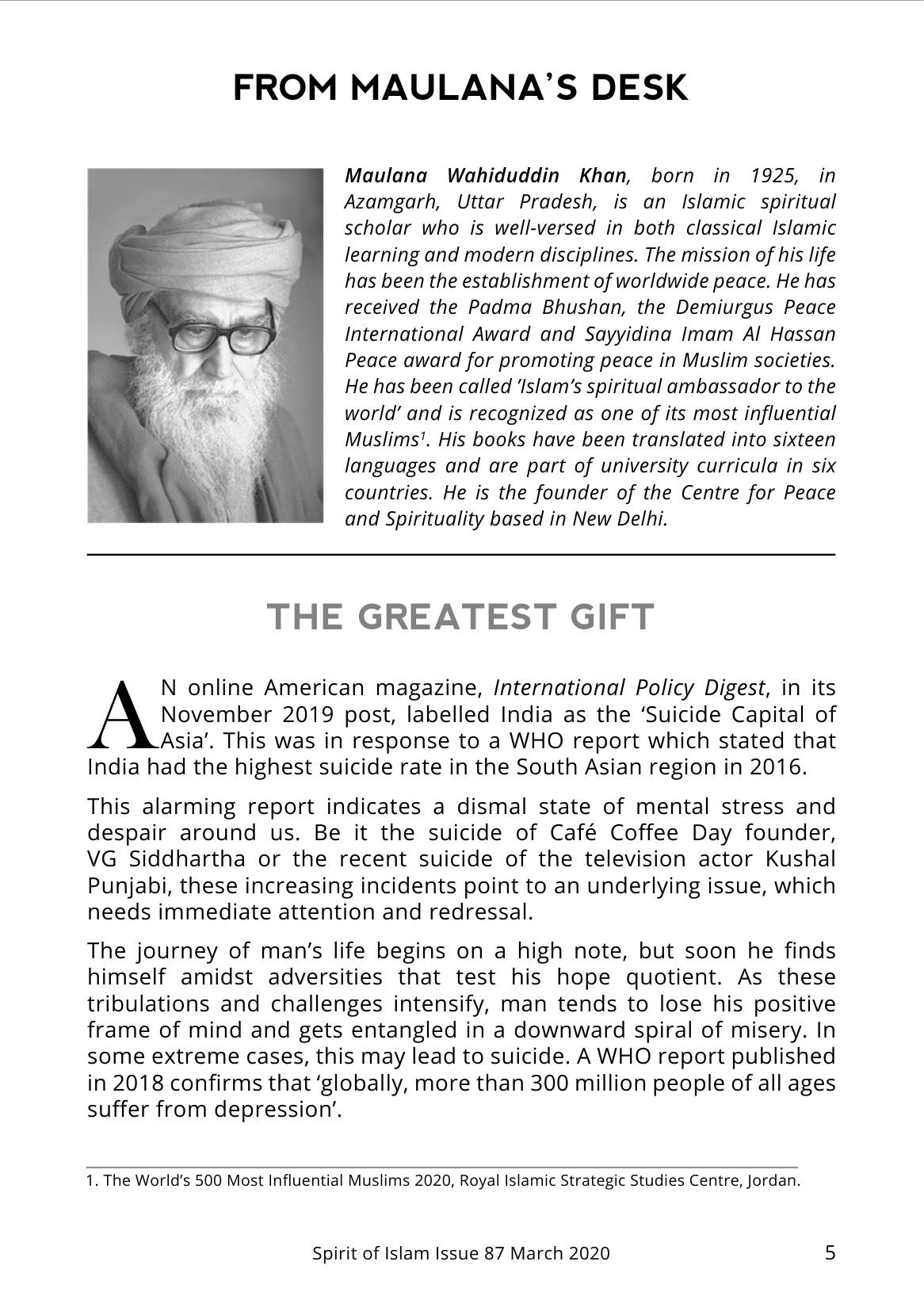
FROM MAULANA’S DESK 1. The World’s 500 Most Influential Muslims 2020, Royal Islamic Strategic Studies Centre, Jordan. Maulana Wahiduddin Khan, born in 1925, in Azamgarh, Uttar Pradesh, is an Islamic spiritual scholar who is well-versed in both classical Islamic learning and modern disciplines. The mission of his life has been the establishment of worldwide peace. He has received the Padma Bhushan, the Demiurgus Peace International Award and Sayyidina Imam Al Hassan Peace award for promoting peace in Muslim societies. He has been called ’Islam’s spiritual ambassador to the world’ and is recognized as one of its most influential Muslims1. His books have been translated into sixteen languages and are part of university curricula in six countries. He is the founder of the Centre for Peace and Spirituality based in New Delhi. THE GREATEST GIFT A N online American magazine, International Policy Digest, in its November 2019 post, labelled India as the ‘Suicide Capital of Asia’. This was in response to a WHO report which stated that India had the highest suicide rate in the South Asian region in 2016. This alarming report indicates a dismal state of mental stress and despair around us. Be it the suicide of Café Coffee Day founder, VG Siddhartha or the recent suicide of the television actor Kushal Punjabi, these increasing incidents point to an underlying issue, which needs immediate attention and redressal. The journey of man’s life begins on a high note, but soon he finds himself amidst adversities that test his hope quotient. As these tribulations and challenges intensify, man tends to lose his positive frame of mind and gets entangled in a downward spiral of misery. In some extreme cases, this may lead to suicide. A WHO report published in 2018 confirms that ‘globally, more than 300 million people of all ages suffer from depression’.
‹ Previous page Next page › About this issue Open in the reader