FROM MAULANA’S DESK
Spirit of Islam, April 2020, p. 5
By Maulana Wahiduddin Khan
Maulana Wahiduddin Khan is named as the default author of the periodical; a piece that carries another writer’s byline is credited to that writer.
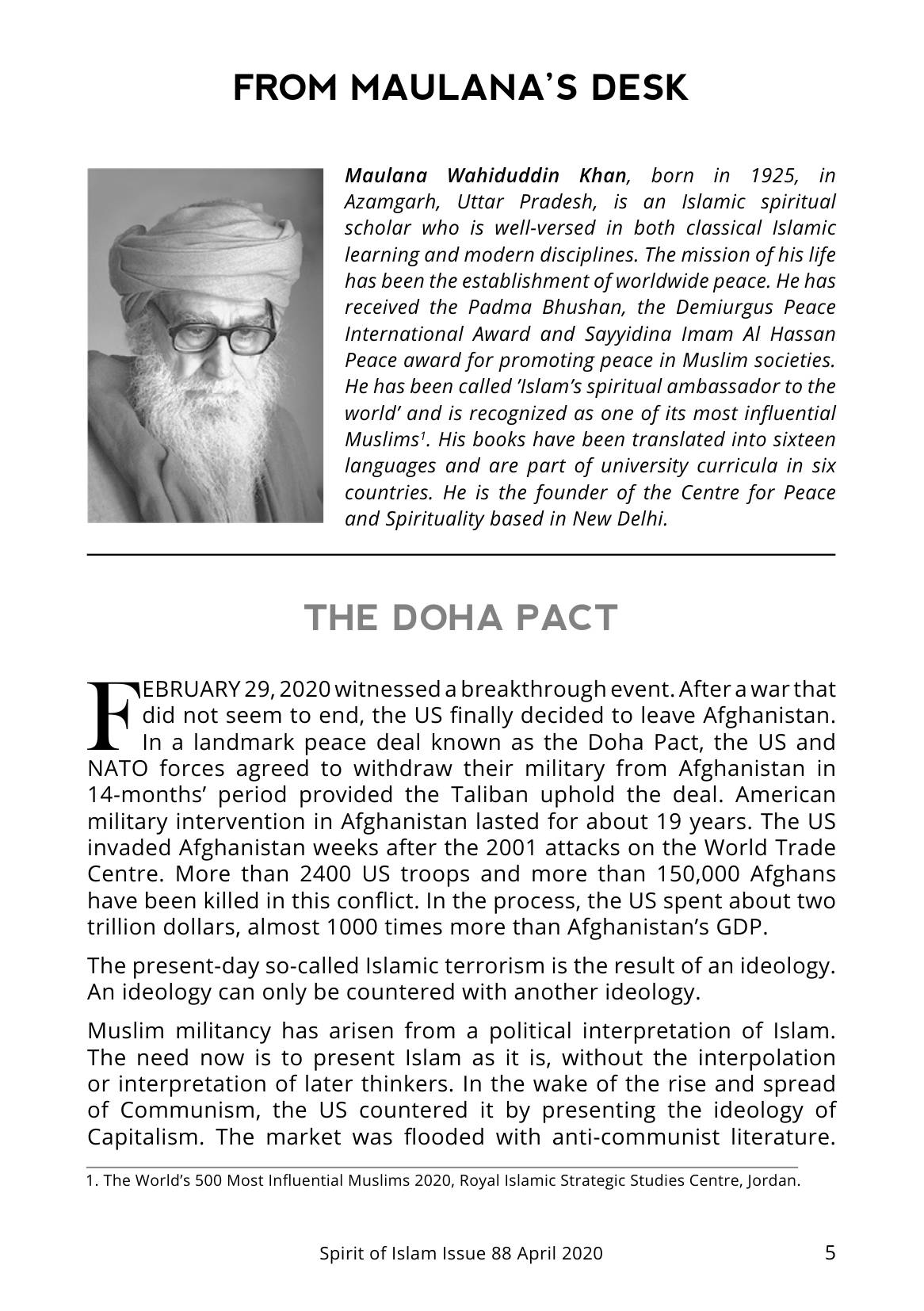
FROM MAULANA’S DESK 1. The World’s 500 Most Influential Muslims 2020, Royal Islamic Strategic Studies Centre, Jordan. Maulana Wahiduddin Khan, born in 1925, in Azamgarh, Uttar Pradesh, is an Islamic spiritual scholar who is well-versed in both classical Islamic learning and modern disciplines. The mission of his life has been the establishment of worldwide peace. He has received the Padma Bhushan, the Demiurgus Peace International Award and Sayyidina Imam Al Hassan Peace award for promoting peace in Muslim societies. He has been called ’Islam’s spiritual ambassador to the world’ and is recognized as one of its most influential Muslims1. His books have been translated into sixteen languages and are part of university curricula in six countries. He is the founder of the Centre for Peace and Spirituality based in New Delhi. THE DOHA PACT FEBRUARY 29, 2020 witnessed a breakthrough event. After a war that did not seem to end, the US finally decided to leave Afghanistan. In a landmark peace deal known as the Doha Pact, the US and NATO forces agreed to withdraw their military from Afghanistan in 14-months’ period provided the Taliban uphold the deal. American military intervention in Afghanistan lasted for about 19 years. The US invaded Afghanistan weeks after the 2001 attacks on the World Trade Centre. More than 2400 US troops and more than 150,000 Afghans have been killed in this conflict. In the process, the US spent about two trillion dollars, almost 1000 times more than Afghanistan’s GDP. The present-day so-called Islamic terrorism is the result of an ideology. An ideology can only be countered with another ideology. Muslim militancy has arisen from a political interpretation of Islam. The need now is to present Islam as it is, without the interpolation or interpretation of later thinkers. In the wake of the rise and spread of Communism, the US countered it by presenting the ideology of Capitalism. The market was flooded with anti-communist literature.
‹ Previous page Next page › About this issue Open in the reader