CLASH BETWEEN SCIENCE AND RELIGION
Spirit of Islam, July 2020, p. 41
By Maulana Wahiduddin Khan
Maulana Wahiduddin Khan is named as the default author of the periodical; a piece that carries another writer’s byline is credited to that writer.
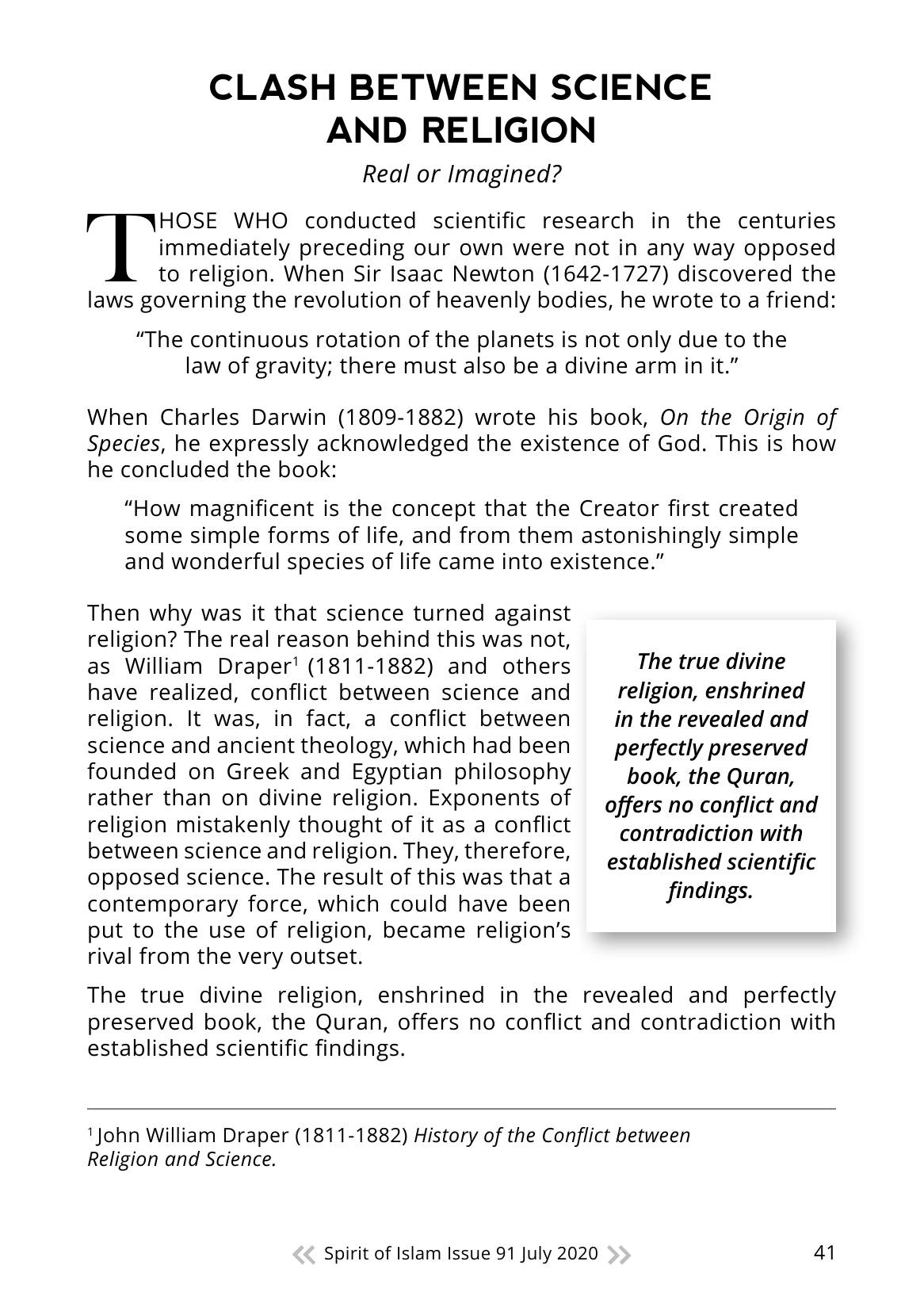
CLASH BETWEEN SCIENCE AND RELIGION Real or Imagined? 1 John William Draper (1811-1882) History of the Conflict between Religion and Science. T HOSE WHO conducted scientific research in the centuries immediately preceding our own were not in any way opposed to religion. When Sir Isaac Newton (1642-1727) discovered the laws governing the revolution of heavenly bodies, he wrote to a friend: “The continuous rotation of the planets is not only due to the law of gravity; there must also be a divine arm in it.” When Charles Darwin (1809-1882) wrote his book, On the Origin of Species, he expressly acknowledged the existence of God. This is how he concluded the book: “How magnificent is the concept that the Creator first created some simple forms of life, and from them astonishingly simple and wonderful species of life came into existence.” Then why was it that science turned against religion? The real reason behind this was not, as William Draper1 (1811-1882) and others have realized, conflict between science and religion. It was, in fact, a conflict between science and ancient theology, which had been founded on Greek and Egyptian philosophy rather than on divine religion. Exponents of religion mistakenly thought of it as a conflict between science and religion. They, therefore, opposed science. The result of this was that a contemporary force, which could have been put to the use of religion, became religion’s rival from the very outset. The true divine religion, enshrined in the revealed and perfectly preserved book, the Quran, offers no conflict and contradiction with established scientific findings. The true divine religion, enshrined in the revealed and perfectly preserved book, the Quran, offers no conflict and contradiction with established scientific findings.
‹ Previous page Next page › About this issue Open in the reader