Spirit of Islam, Aug 2020
Spirit of Islam, Aug 2020, p. 18
By Maulana Wahiduddin Khan
Maulana Wahiduddin Khan is named as the default author of the periodical; a piece that carries another writer’s byline is credited to that writer.
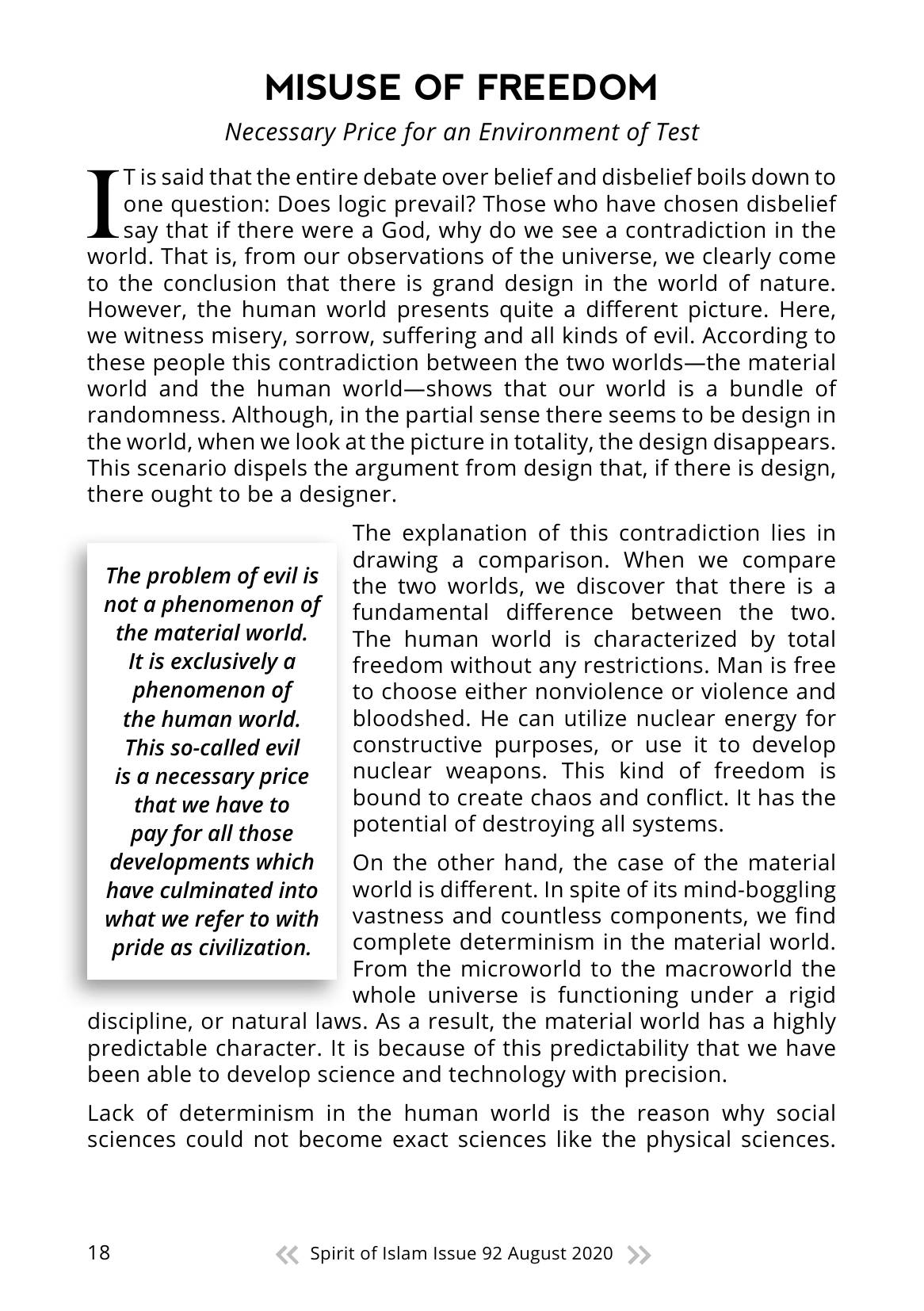
The problem of evil is not a phenomenon of the material world. It is exclusively a phenomenon of the human world. This so-called evil is a necessary price that we have to pay for all those developments which have culminated into what we refer to with pride as civilization. MISUSE OF FREEDOM Necessary Price for an Environment of Test I T is said that the entire debate over belief and disbelief boils down to one question: Does logic prevail? Those who have chosen disbelief say that if there were a God, why do we see a contradiction in the world. That is, from our observations of the universe, we clearly come to the conclusion that there is grand design in the world of nature. However, the human world presents quite a different picture. Here, we witness misery, sorrow, suffering and all kinds of evil. According to these people this contradiction between the two worlds—the material world and the human world—shows that our world is a bundle of randomness. Although, in the partial sense there seems to be design in the world, when we look at the picture in totality, the design disappears. This scenario dispels the argument from design that, if there is design, there ought to be a designer. The explanation of this contradiction lies in drawing a comparison. When we compare the two worlds, we discover that there is a fundamental difference between the two. The human world is characterized by total freedom without any restrictions. Man is free to choose either nonviolence or violence and bloodshed. He can utilize nuclear energy for constructive purposes, or use it to develop nuclear weapons. This kind of freedom is bound to create chaos and conflict. It has the potential of destroying all systems. On the other hand, the case of the material world is different. In spite of its mind-boggling vastness and countless components, we find complete determinism in the material world. From the microworld to the macroworld the whole universe is functioning under a rigid discipline, or natural laws. As a result, the material world has a highly predictable character. It is because of this predictability that we have been able to develop science and technology with precision. Lack of determinism in the human world is the reason why social sciences could not become exact sciences like the physical sciences.
‹ Previous page Next page › About this issue Open in the reader