THE WORD OF GOD
Spirit of Islam, Sept 2020, p. 46
By Maulana Wahiduddin Khan
Maulana Wahiduddin Khan is named as the default author of the periodical; a piece that carries another writer’s byline is credited to that writer.
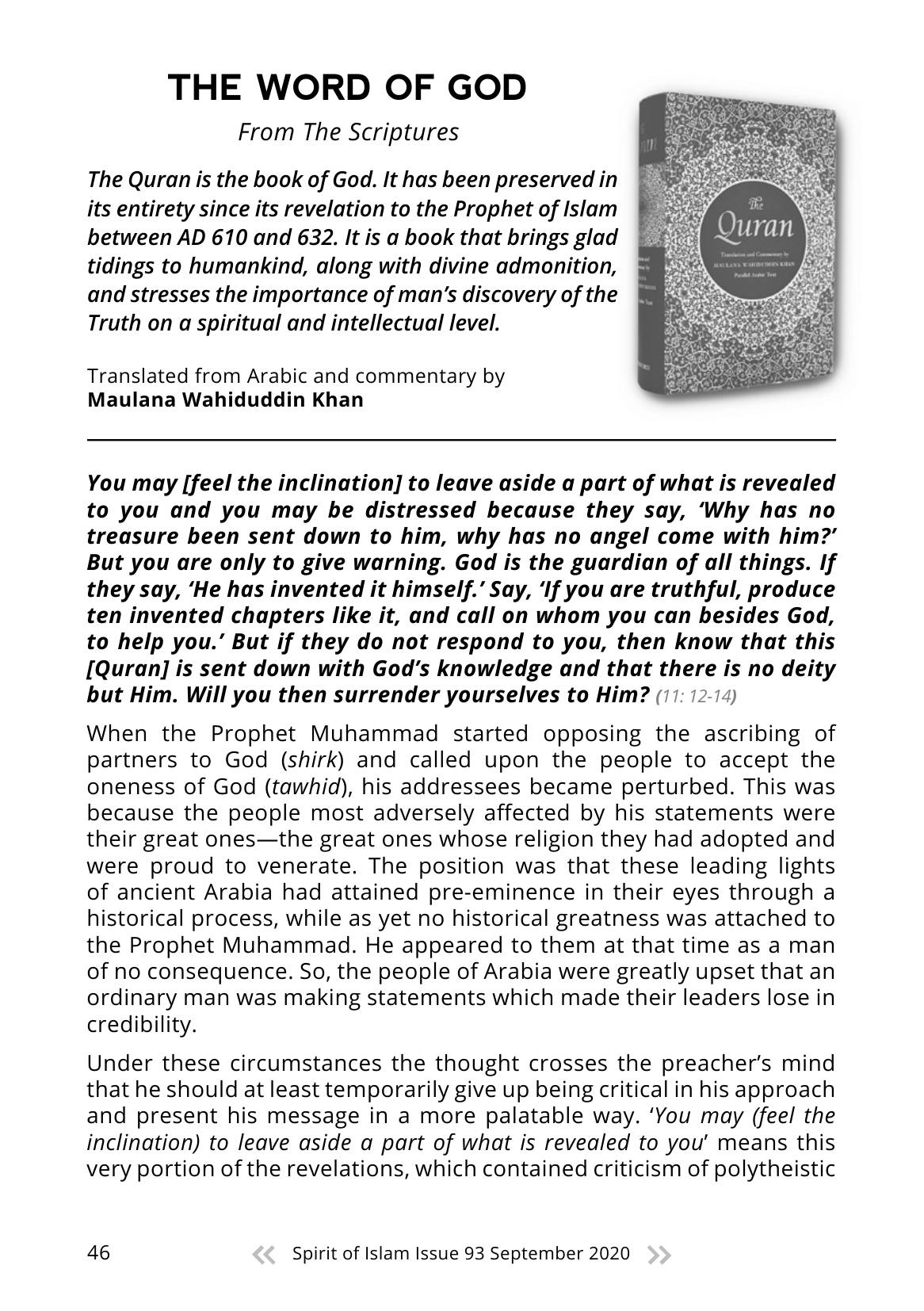
THE WORD OF GOD From The Scriptures The Quran is the book of God. It has been preserved in its entirety since its revelation to the Prophet of Islam between AD 610 and 632. It is a book that brings glad tidings to humankind, along with divine admonition, and stresses the importance of man’s discovery of the Truth on a spiritual and intellectual level. Translated from Arabic and commentary by Maulana Wahiduddin Khan You may [feel the inclination] to leave aside a part of what is revealed to you and you may be distressed because they say, ‘Why has no treasure been sent down to him, why has no angel come with him?’ But you are only to give warning. God is the guardian of all things. If they say, ‘He has invented it himself.’ Say, ‘If you are truthful, produce ten invented chapters like it, and call on whom you can besides God, to help you.’ But if they do not respond to you, then know that this [Quran] is sent down with God’s knowledge and that there is no deity but Him. Will you then surrender yourselves to Him? (11: 12-14) When the Prophet Muhammad started opposing the ascribing of partners to God (shirk) and called upon the people to accept the oneness of God (tawhid), his addressees became perturbed. This was because the people most adversely affected by his statements were their great ones—the great ones whose religion they had adopted and were proud to venerate. The position was that these leading lights of ancient Arabia had attained pre-eminence in their eyes through a historical process, while as yet no historical greatness was attached to the Prophet Muhammad. He appeared to them at that time as a man of no consequence. So, the people of Arabia were greatly upset that an ordinary man was making statements which made their leaders lose in credibility. Under these circumstances the thought crosses the preacher’s mind that he should at least temporarily give up being critical in his approach and present his message in a more palatable way. ‘You may (feel the inclination) to leave aside a part of what is revealed to you’ means this very portion of the revelations, which contained criticism of polytheistic
‹ Previous page Next page › About this issue Open in the reader