PARADISE: A UNIVERSAL CONCEPT
Spirit of Islam, Nov 2020, p. 35
By Maulana Wahiduddin Khan
Maulana Wahiduddin Khan is named as the default author of the periodical; a piece that carries another writer’s byline is credited to that writer.
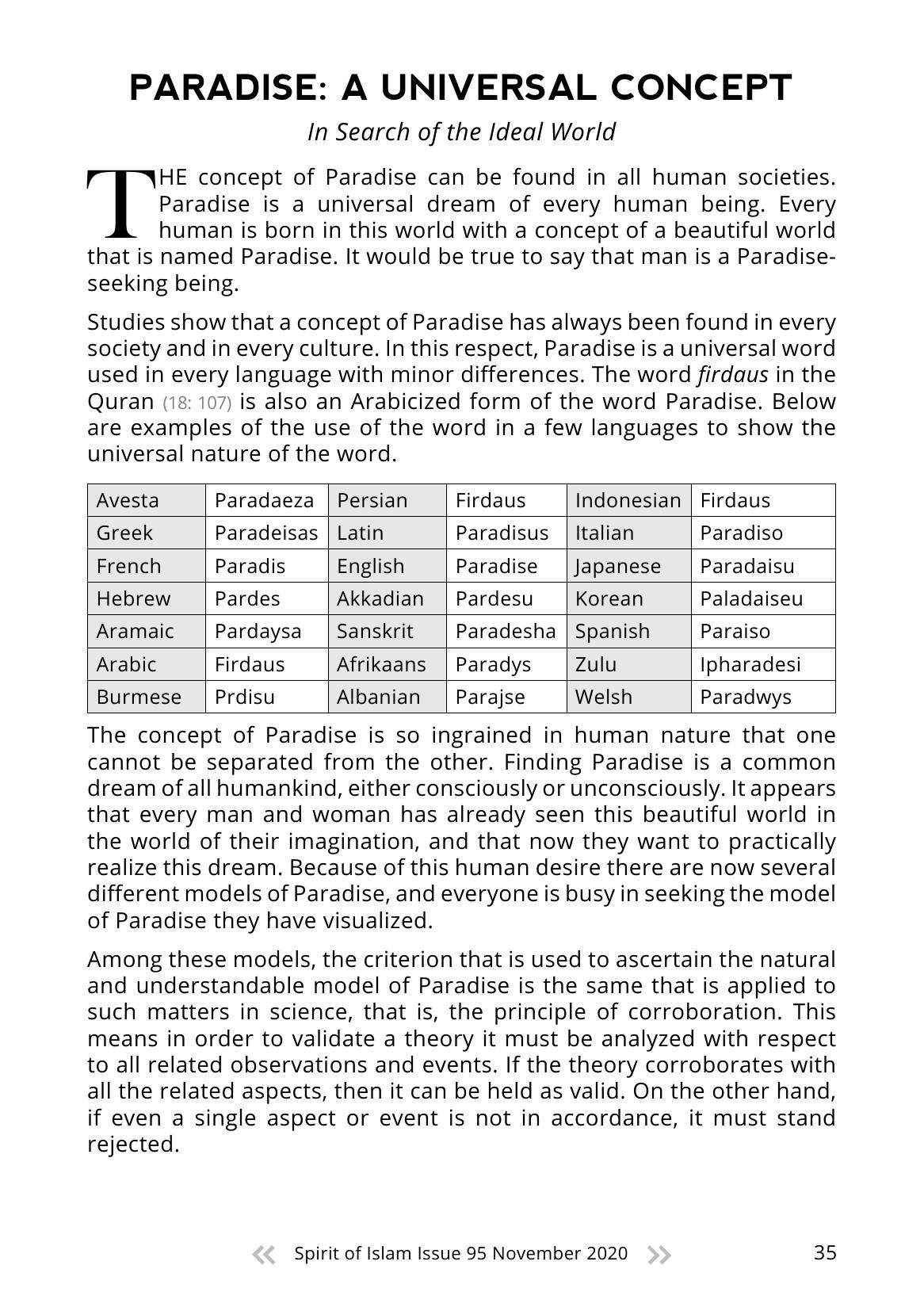
PARADISE: A UNIVERSAL CONCEPT In Search of the Ideal World T HE concept of Paradise can be found in all human societies. Paradise is a universal dream of every human being. Every human is born in this world with a concept of a beautiful world that is named Paradise. It would be true to say that man is a Paradiseseeking being. Studies show that a concept of Paradise has always been found in every society and in every culture. In this respect, Paradise is a universal word used in every language with minor differences. The word firdaus in the Quran (18: 107) is also an Arabicized form of the word Paradise. Below are examples of the use of the word in a few languages to show the universal nature of the word. Avesta Paradaeza Persian Firdaus Indonesian Firdaus Greek Paradeisas Latin Paradisus Italian Paradiso French Paradis English Paradise Japanese Paradaisu Hebrew Pardes Akkadian Pardesu Korean Paladaiseu Aramaic Pardaysa Sanskrit Paradesha Spanish Paraiso Arabic Firdaus Afrikaans Paradys Zulu Ipharadesi Burmese Prdisu Albanian Parajse Welsh Paradwys The concept of Paradise is so ingrained in human nature that one cannot be separated from the other. Finding Paradise is a common dream of all humankind, either consciously or unconsciously. It appears that every man and woman has already seen this beautiful world in the world of their imagination, and that now they want to practically realize this dream. Because of this human desire there are now several different models of Paradise, and everyone is busy in seeking the model of Paradise they have visualized. Among these models, the criterion that is used to ascertain the natural and understandable model of Paradise is the same that is applied to such matters in science, that is, the principle of corroboration. This means in order to validate a theory it must be analyzed with respect to all related observations and events. If the theory corroborates with all the related aspects, then it can be held as valid. On the other hand, if even a single aspect or event is not in accordance, it must stand rejected.
‹ Previous page Next page › About this issue Open in the reader