FROM MAULANA’S DESK
Spirit of Islam, Nov 2020, p. 5
By Maulana Wahiduddin Khan
Maulana Wahiduddin Khan is named as the default author of the periodical; a piece that carries another writer’s byline is credited to that writer.
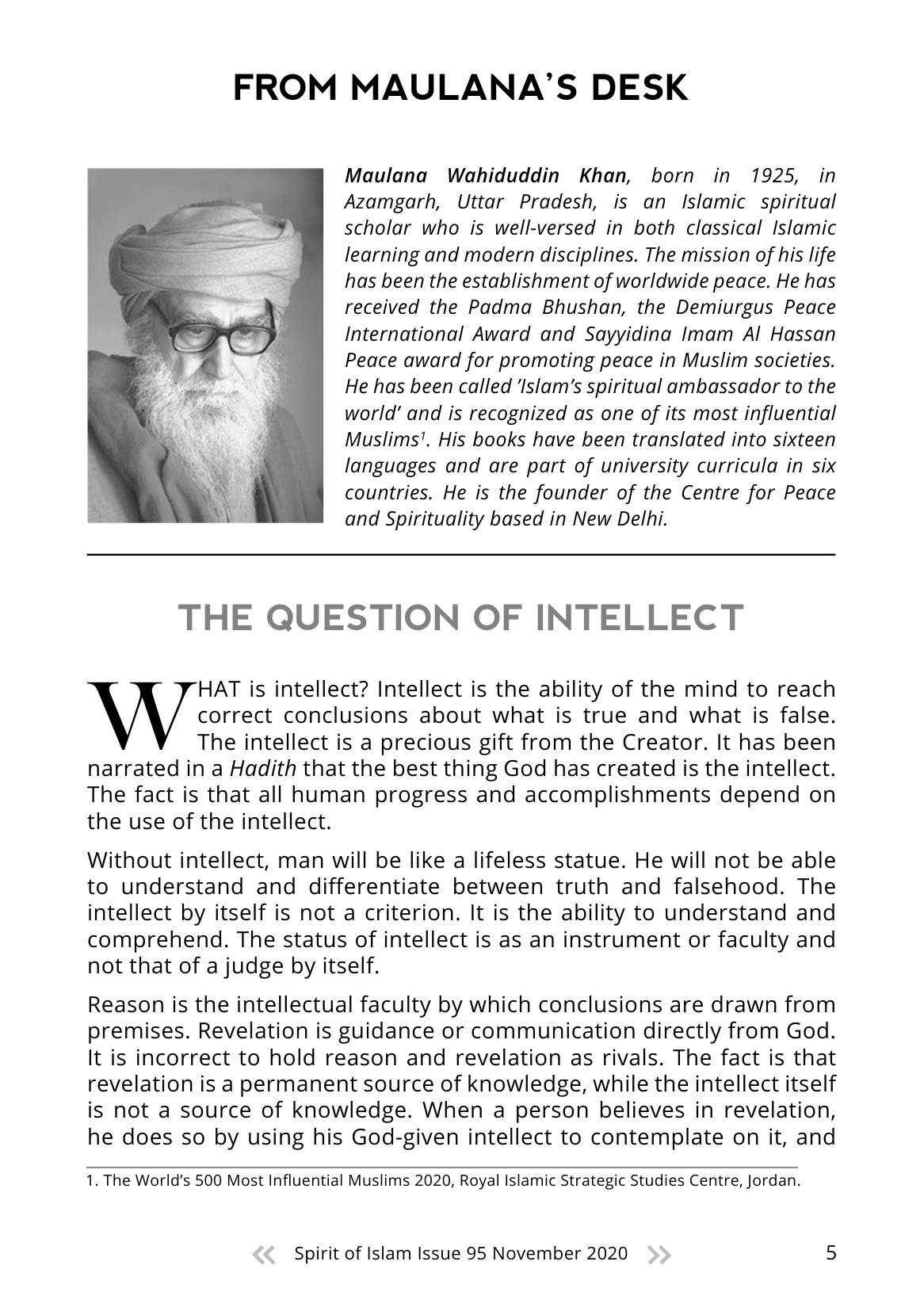
FROM MAULANA’S DESK 1. The World’s 500 Most Influential Muslims 2020, Royal Islamic Strategic Studies Centre, Jordan. Maulana Wahiduddin Khan, born in 1925, in Azamgarh, Uttar Pradesh, is an Islamic spiritual scholar who is well-versed in both classical Islamic learning and modern disciplines. The mission of his life has been the establishment of worldwide peace. He has received the Padma Bhushan, the Demiurgus Peace International Award and Sayyidina Imam Al Hassan Peace award for promoting peace in Muslim societies. He has been called ’Islam’s spiritual ambassador to the world’ and is recognized as one of its most influential Muslims1. His books have been translated into sixteen languages and are part of university curricula in six countries. He is the founder of the Centre for Peace and Spirituality based in New Delhi. THE QUESTION OF INTELLECT W HAT is intellect? Intellect is the ability of the mind to reach correct conclusions about what is true and what is false. The intellect is a precious gift from the Creator. It has been narrated in a Hadith that the best thing God has created is the intellect. The fact is that all human progress and accomplishments depend on the use of the intellect. Without intellect, man will be like a lifeless statue. He will not be able to understand and differentiate between truth and falsehood. The intellect by itself is not a criterion. It is the ability to understand and comprehend. The status of intellect is as an instrument or faculty and not that of a judge by itself. Reason is the intellectual faculty by which conclusions are drawn from premises. Revelation is guidance or communication directly from God. It is incorrect to hold reason and revelation as rivals. The fact is that revelation is a permanent source of knowledge, while the intellect itself is not a source of knowledge. When a person believes in revelation, he does so by using his God-given intellect to contemplate on it, and
‹ Previous page Next page › About this issue Open in the reader