BOOK REVIEW
Spirit of Islam, July-August 2021, p. 37
By Maulana Wahiduddin Khan
Maulana Wahiduddin Khan is named as the default author of the periodical; a piece that carries another writer’s byline is credited to that writer.
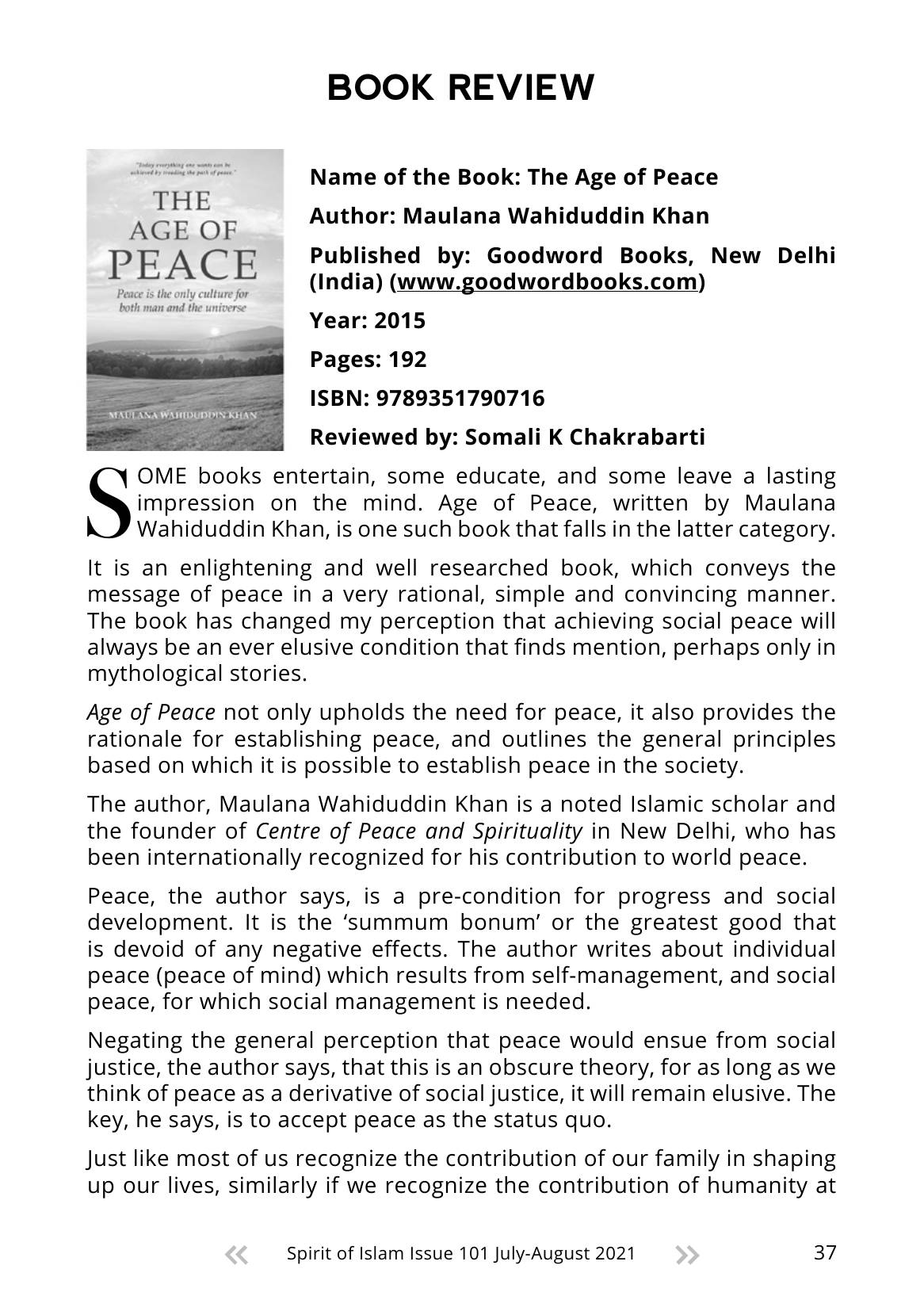
BOOK REVIEW Name of the Book: The Age of Peace Author: Maulana Wahiduddin Khan Published by: Goodword Books, New Delhi (India) (www.goodwordbooks.com) Year: 2015 Pages: 192 ISBN: 9789351790716 Reviewed by: Somali K Chakrabarti S OME books entertain, some educate, and some leave a lasting impression on the mind. Age of Peace, written by Maulana Wahiduddin Khan, is one such book that falls in the latter category. It is an enlightening and well researched book, which conveys the message of peace in a very rational, simple and convincing manner. The book has changed my perception that achieving social peace will always be an ever elusive condition that finds mention, perhaps only in mythological stories. Age of Peace not only upholds the need for peace, it also provides the rationale for establishing peace, and outlines the general principles based on which it is possible to establish peace in the society. The author, Maulana Wahiduddin Khan is a noted Islamic scholar and the founder of Centre of Peace and Spirituality in New Delhi, who has been internationally recognized for his contribution to world peace. Peace, the author says, is a pre-condition for progress and social development. It is the ‘summum bonum’ or the greatest good that is devoid of any negative effects. The author writes about individual peace (peace of mind) which results from self-management, and social peace, for which social management is needed. Negating the general perception that peace would ensue from social justice, the author says, that this is an obscure theory, for as long as we think of peace as a derivative of social justice, it will remain elusive. The key, he says, is to accept peace as the status quo. Just like most of us recognize the contribution of our family in shaping up our lives, similarly if we recognize the contribution of humanity at
‹ Previous page Next page › About this issue Open in the reader