Spirit of Islam, Nov-Dec 2021
Spirit of Islam, Nov-Dec 2021, p. 5
By Maulana Wahiduddin Khan
Maulana Wahiduddin Khan is named as the default author of the periodical; a piece that carries another writer’s byline is credited to that writer.
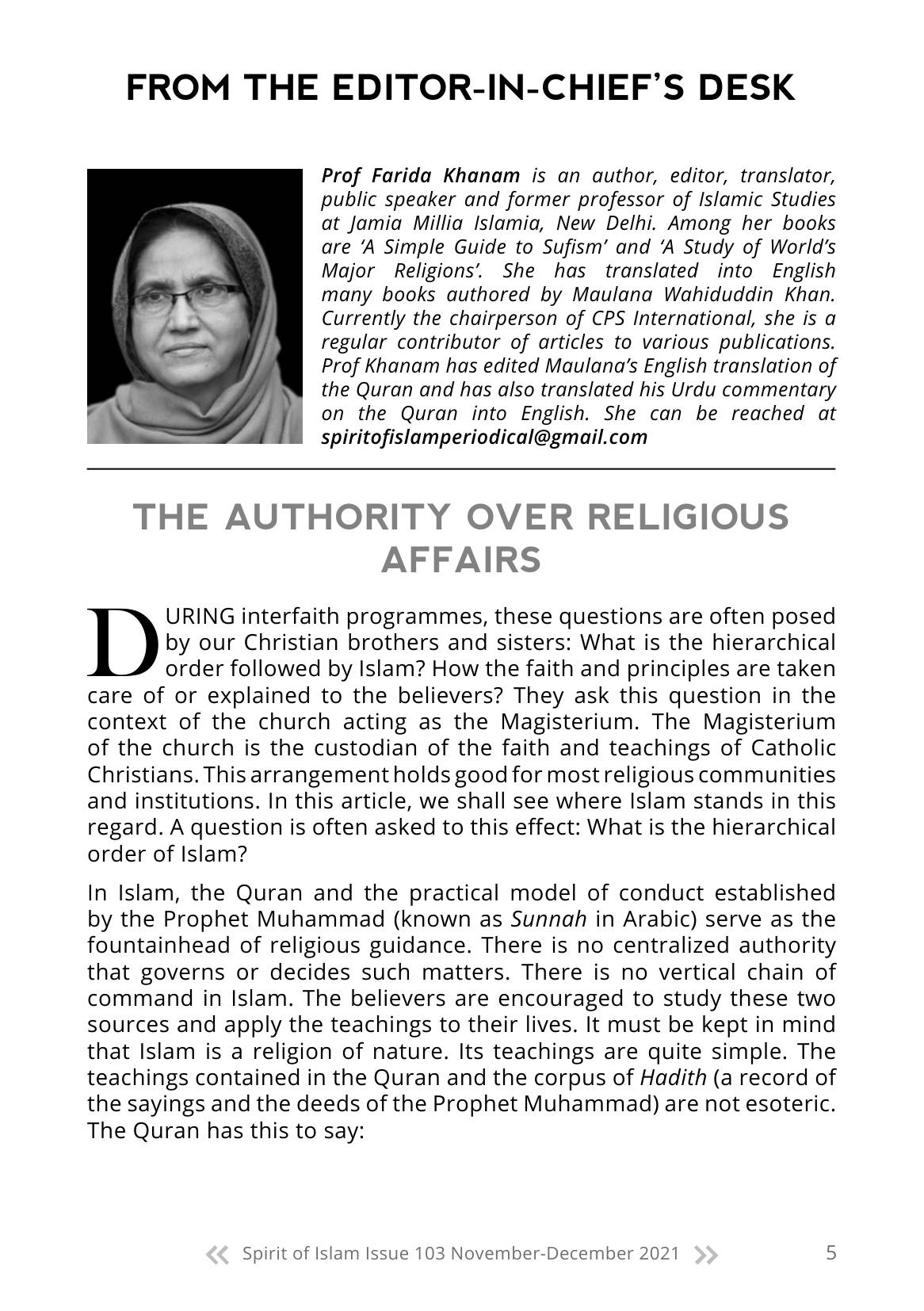
FROM THE EDITOR-IN-CHIEF’S DESK Prof Farida Khanam is an author, editor, translator, public speaker and former professor of Islamic Studies at Jamia Millia Islamia, New Delhi. Among her books are ‘A Simple Guide to Sufism’ and ‘A Study of World’s Major Religions’. She has translated into English many books authored by Maulana Wahiduddin Khan. Currently the chairperson of CPS International, she is a regular contributor of articles to various publications. Prof Khanam has edited Maulana’s English translation of the Quran and has also translated his Urdu commentary on the Quran into English. She can be reached at spiritofislamperiodical@gmail.com THE AUTHORITY OVER RELIGIOUS AFFAIRS D URING interfaith programmes, these questions are often posed by our Christian brothers and sisters: What is the hierarchical order followed by Islam? How the faith and principles are taken care of or explained to the believers? They ask this question in the context of the church acting as the Magisterium. The Magisterium of the church is the custodian of the faith and teachings of Catholic Christians. This arrangement holds good for most religious communities and institutions. In this article, we shall see where Islam stands in this regard. A question is often asked to this effect: What is the hierarchical order of Islam? In Islam, the Quran and the practical model of conduct established by the Prophet Muhammad (known as Sunnah in Arabic) serve as the fountainhead of religious guidance. There is no centralized authority that governs or decides such matters. There is no vertical chain of command in Islam. The believers are encouraged to study these two sources and apply the teachings to their lives. It must be kept in mind that Islam is a religion of nature. Its teachings are quite simple. The teachings contained in the Quran and the corpus of Hadith (a record of the sayings and the deeds of the Prophet Muhammad) are not esoteric. The Quran has this to say:
‹ Previous page Next page › About this issue Open in the reader