THE LIFE AND WORK OF MAULANA WAHIDUDDIN KHAN
Spirit of Islam, May-June 2022, p. 22
By Maulana Wahiduddin Khan
Maulana Wahiduddin Khan is named as the default author of the periodical; a piece that carries another writer’s byline is credited to that writer.
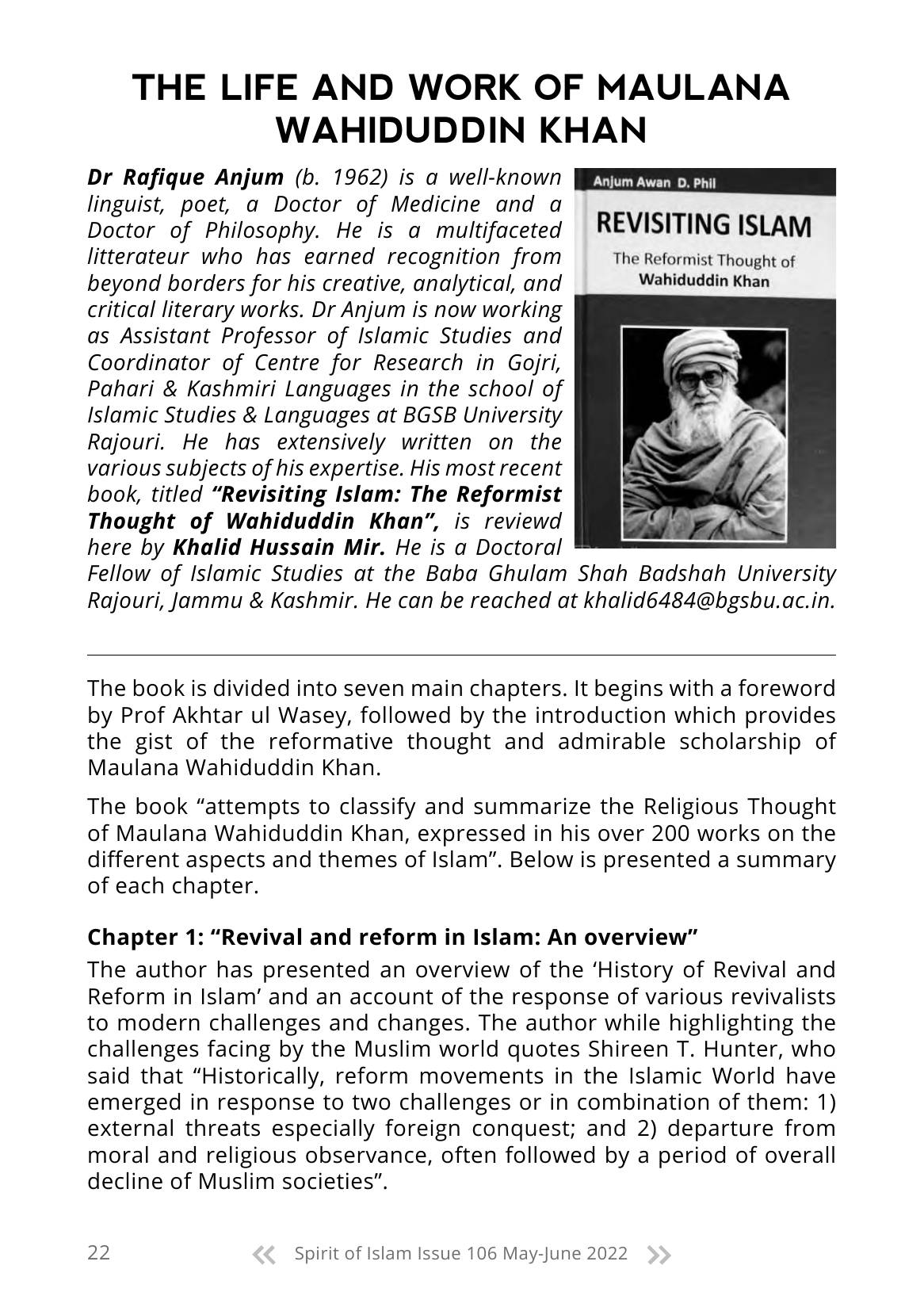
THE LIFE AND WORK OF MAULANA WAHIDUDDIN KHAN Dr Rafique Anjum (b. 1962) is a well-known linguist, poet, a Doctor of Medicine and a Doctor of Philosophy. He is a multifaceted litterateur who has earned recognition from beyond borders for his creative, analytical, and critical literary works. Dr Anjum is now working as Assistant Professor of Islamic Studies and Coordinator of Centre for Research in Gojri, Pahari & Kashmiri Languages in the school of Islamic Studies & Languages at BGSB University Rajouri. He has extensively written on the various subjects of his expertise. His most recent book, titled “Revisiting Islam: The Reformist Thought of Wahiduddin Khan”, is reviewd here by Khalid Hussain Mir. He is a Doctoral Fellow of Islamic Studies at the Baba Ghulam Shah Badshah University Rajouri, Jammu & Kashmir. He can be reached at khalid6484@bgsbu.ac.in. The book is divided into seven main chapters. It begins with a foreword by Prof Akhtar ul Wasey, followed by the introduction which provides the gist of the reformative thought and admirable scholarship of Maulana Wahiduddin Khan. The book “attempts to classify and summarize the Religious Thought of Maulana Wahiduddin Khan, expressed in his over 200 works on the different aspects and themes of Islam”. Below is presented a summary of each chapter. Chapter 1: “Revival and reform in Islam: An overview” The author has presented an overview of the ‘History of Revival and Reform in Islam’ and an account of the response of various revivalists to modern challenges and changes. The author while highlighting the challenges facing by the Muslim world quotes Shireen T. Hunter, who said that “Historically, reform movements in the Islamic World have emerged in response to two challenges or in combination of them: 1) external threats especially foreign conquest; and 2) departure from moral and religious observance, often followed by a period of overall decline of Muslim societies”.
‹ Previous page Next page › About this issue Open in the reader