AN INTERVIEW WITH DR RAJAT MALHOTRA
Spirit of Islam, Sept-Oct 2022, p. 34
By Maulana Wahiduddin Khan
Maulana Wahiduddin Khan is named as the default author of the periodical; a piece that carries another writer’s byline is credited to that writer.
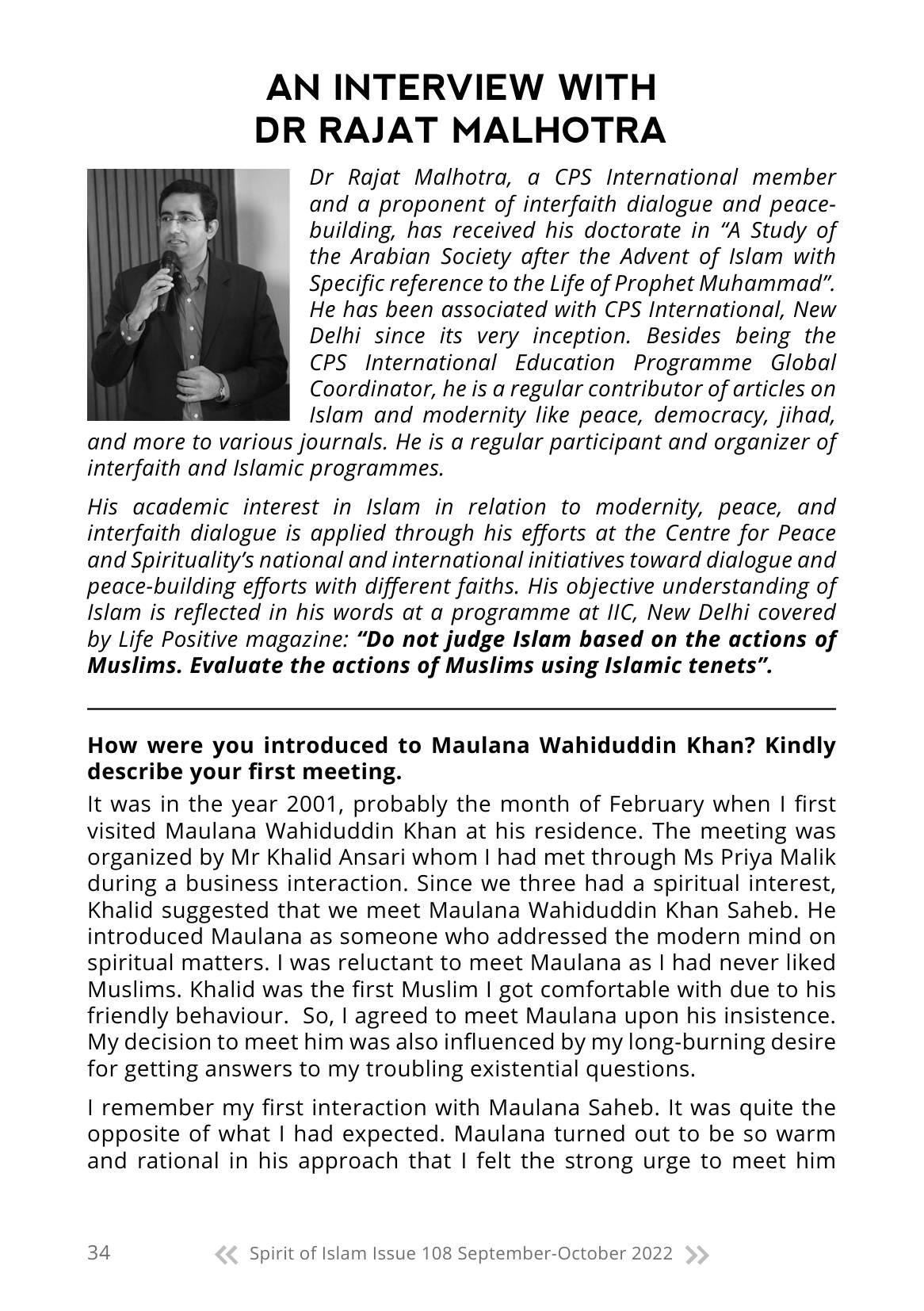
AN INTERVIEW WITH DR RAJAT MALHOTRA Dr Rajat Malhotra, a CPS International member and a proponent of interfaith dialogue and peacebuilding, has received his doctorate in “A Study of the Arabian Society after the Advent of Islam with Specific reference to the Life of Prophet Muhammad”. He has been associated with CPS International, New Delhi since its very inception. Besides being the CPS International Education Programme Global Coordinator, he is a regular contributor of articles on Islam and modernity like peace, democracy, jihad, and more to various journals. He is a regular participant and organizer of interfaith and Islamic programmes. His academic interest in Islam in relation to modernity, peace, and interfaith dialogue is applied through his efforts at the Centre for Peace and Spirituality’s national and international initiatives toward dialogue and peace-building efforts with different faiths. His objective understanding of Islam is reflected in his words at a programme at IIC, New Delhi covered by Life Positive magazine: “Do not judge Islam based on the actions of Muslims. Evaluate the actions of Muslims using Islamic tenets”. How were you introduced to Maulana Wahiduddin Khan? Kindly describe your first meeting. It was in the year 2001, probably the month of February when I first visited Maulana Wahiduddin Khan at his residence. The meeting was organized by Mr Khalid Ansari whom I had met through Ms Priya Malik during a business interaction. Since we three had a spiritual interest, Khalid suggested that we meet Maulana Wahiduddin Khan Saheb. He introduced Maulana as someone who addressed the modern mind on spiritual matters. I was reluctant to meet Maulana as I had never liked Muslims. Khalid was the first Muslim I got comfortable with due to his friendly behaviour. So, I agreed to meet Maulana upon his insistence. My decision to meet him was also influenced by my long-burning desire for getting answers to my troubling existential questions. I remember my first interaction with Maulana Saheb. It was quite the opposite of what I had expected. Maulana turned out to be so warm and rational in his approach that I felt the strong urge to meet him
‹ Previous page Next page › About this issue Open in the reader