THE TEST OF POWER
Spirit of Islam, July-August 2026, p. 6
By Maulana Wahiduddin Khan
Maulana Wahiduddin Khan is named as the default author of the periodical; a piece that carries another writer’s byline is credited to that writer.
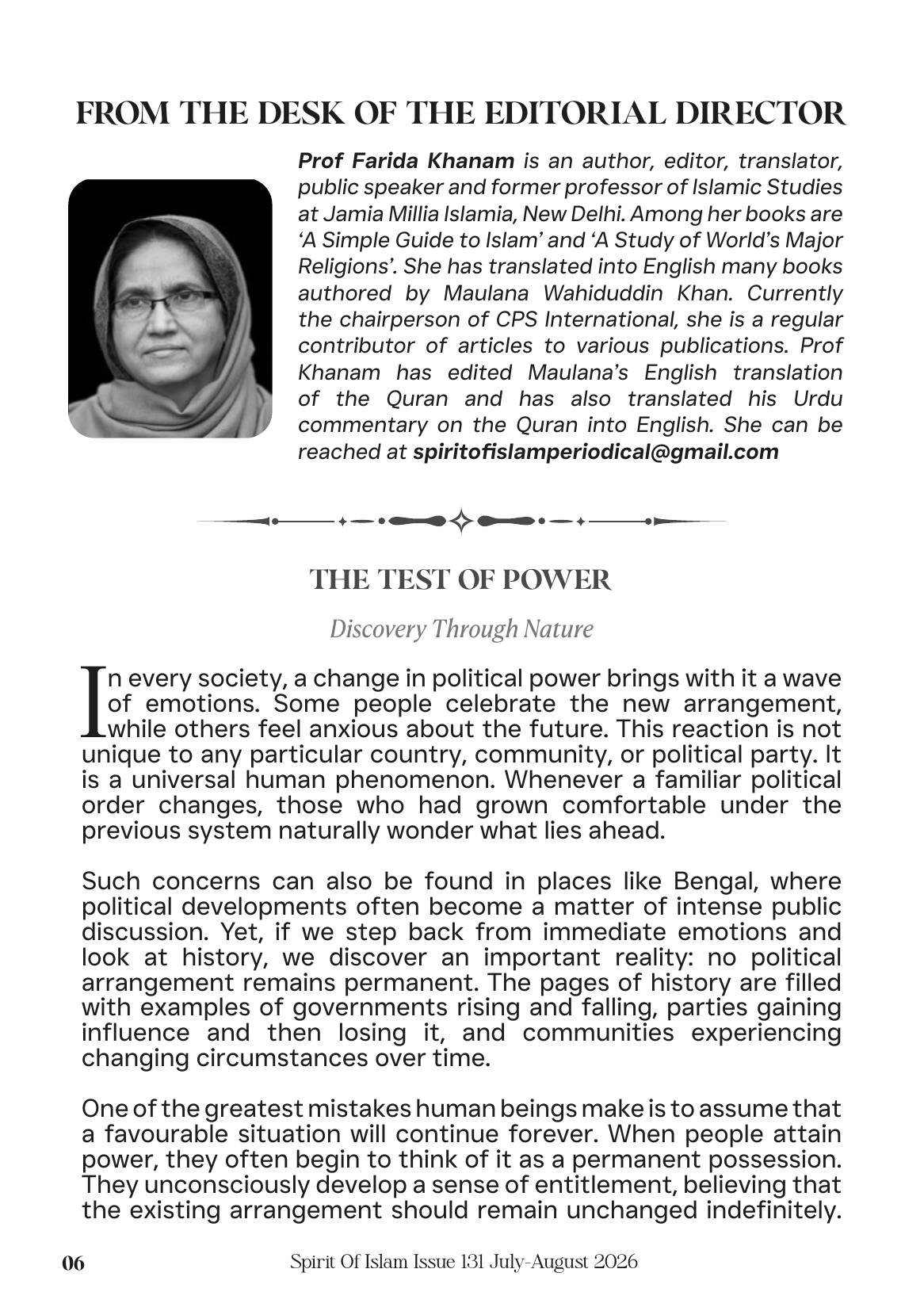
FROM THE DESK OF THE EDITORIAL DIRECTOR THE TEST OF POWER Prof Farida Khanam is an author, editor, translator, public speaker and former professor of Islamic Studies at Jamia Millia Islamia, New Delhi. Among her books are ‘A Simple Guide to Islam’ and ‘A Study of World’s Major Religions’. She has translated into English many books authored by Maulana Wahiduddin Khan. Currently the chairperson of CPS International, she is a regular contributor of articles to various publications. Prof Khanam has edited Maulana’s English translation of the Quran and has also translated his Urdu commentary on the Quran into English. She can be reached at spiritofislamperiodical@gmail.com I n every society, a change in political power brings with it a wave of emotions. Some people celebrate the new arrangement, while others feel anxious about the future. This reaction is not unique to any particular country, community, or political party. It is a universal human phenomenon. Whenever a familiar political order changes, those who had grown comfortable under the previous system naturally wonder what lies ahead. Such concerns can also be found in places like Bengal, where political developments often become a matter of intense public discussion. Yet, if we step back from immediate emotions and look at history, we discover an important reality: no political arrangement remains permanent. The pages of history are filled with examples of governments rising and falling, parties gaining influence and then losing it, and communities experiencing changing circumstances over time. One of the greatest mistakes human beings make is to assume that a favourable situation will continue forever. When people attain power, they often begin to think of it as a permanent possession. They unconsciously develop a sense of entitlement, believing that the existing arrangement should remain unchanged indefinitely. Discovery Through Nature
‹ Previous page Next page › About this issue Open in the reader