FROM THE DESK OF THE EDITORIAL DIRECTOR THE GIFT OF CRITICISM
Spirit of Islam, Sep-Oct 2026, p. 6
By Maulana Wahiduddin Khan
Maulana Wahiduddin Khan is named as the default author of the periodical; a piece that carries another writer’s byline is credited to that writer.
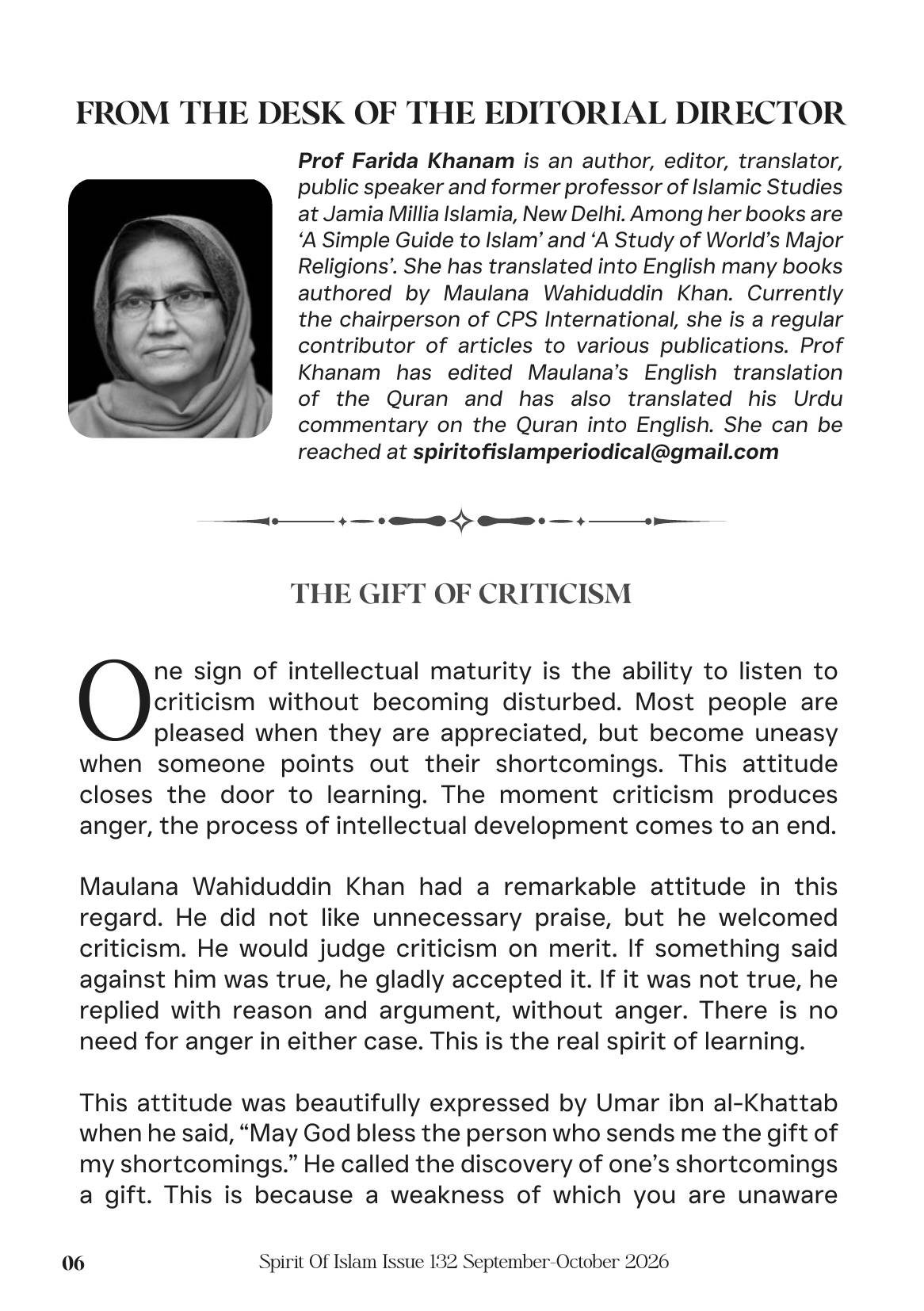
FROM THE DESK OF THE EDITORIAL DIRECTOR THE GIFT OF CRITICISM Prof Farida Khanam is an author, editor, translator, public speaker and former professor of Islamic Studies at Jamia Millia Islamia, New Delhi. Among her books are ‘A Simple Guide to Islam’ and ‘A Study of World’s Major Religions’. She has translated into English many books authored by Maulana Wahiduddin Khan. Currently the chairperson of CPS International, she is a regular contributor of articles to various publications. Prof Khanam has edited Maulana’s English translation of the Quran and has also translated his Urdu commentary on the Quran into English. She can be reached at spiritofislamperiodical@gmail.com O ne sign of intellectual maturity is the ability to listen to criticism without becoming disturbed. Most people are pleased when they are appreciated, but become uneasy when someone points out their shortcomings. This attitude closes the door to learning. The moment criticism produces anger, the process of intellectual development comes to an end. Maulana Wahiduddin Khan had a remarkable attitude in this regard. He did not like unnecessary praise, but he welcomed criticism. He would judge criticism on merit. If something said against him was true, he gladly accepted it. If it was not true, he replied with reason and argument, without anger. There is no need for anger in either case. This is the real spirit of learning. This attitude was beautifully expressed by Umar ibn al-Khattab when he said, “May God bless the person who sends me the gift of my shortcomings.” He called the discovery of one’s shortcomings a gift. This is because a weakness of which you are unaware
‹ Previous page Next page › About this issue Open in the reader