Islamic Fundamentalism
English book, p. 132
By Maulana Wahiduddin Khan
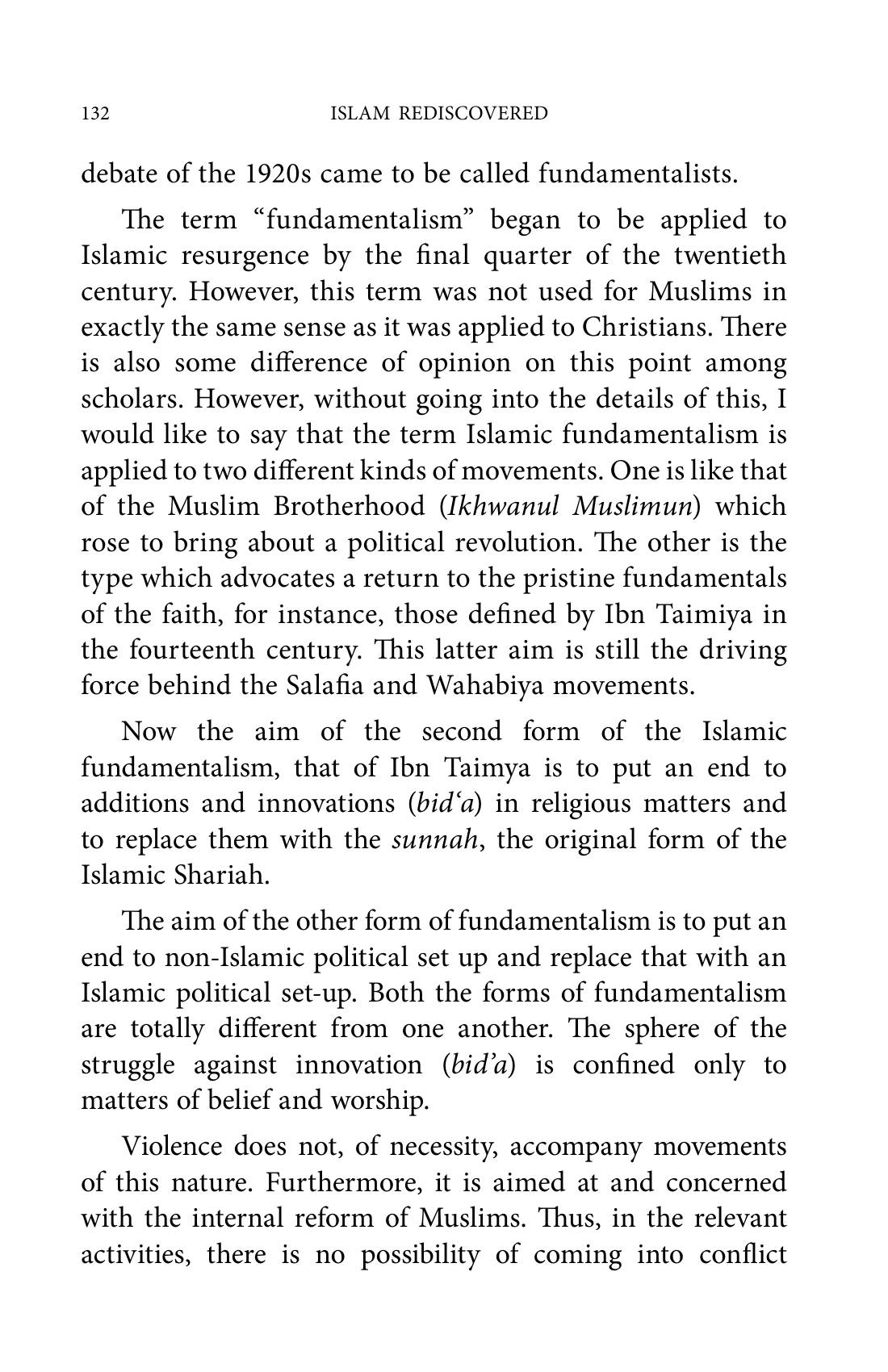
debate of the 1920s came to be called fundamentalists. The term “fundamentalism” began to be applied to Islamic resurgence by the final quarter of the twentieth century. However, this term was not used for Muslims in exactly the same sense as it was applied to Christians. There is also some difference of opinion on this point among scholars. However, without going into the details of this, I would like to say that the term Islamic fundamentalism is applied to two different kinds of movements. One is like that of the Muslim Brotherhood (Ikhwanul Muslimun) which rose to bring about a political revolution. The other is the type which advocates a return to the pristine fundamentals of the faith, for instance, those defined by Ibn Taimiya in the fourteenth century. This latter aim is still the driving force behind the Salafia and Wahabiya movements. Now the aim of the second form of the Islamic fundamentalism, that of Ibn Taimya is to put an end to additions and innovations (bid‘a) in religious matters and to replace them with the sunnah, the original form of the Islamic Shariah. The aim of the other form of fundamentalism is to put an end to non-Islamic political set up and replace that with an Islamic political set-up. Both the forms of fundamentalism are totally different from one another. The sphere of the struggle against innovation (bid’a) is confined only to matters of belief and worship. Violence does not, of necessity, accompany movements of this nature. Furthermore, it is aimed at and concerned with the internal reform of Muslims. Thus, in the relevant activities, there is no possibility of coming into conflict
‹ Previous page Next page › About this book Open in the reader