The Leadership Role of Scholars
English book, p. 39
By Maulana Wahiduddin Khan
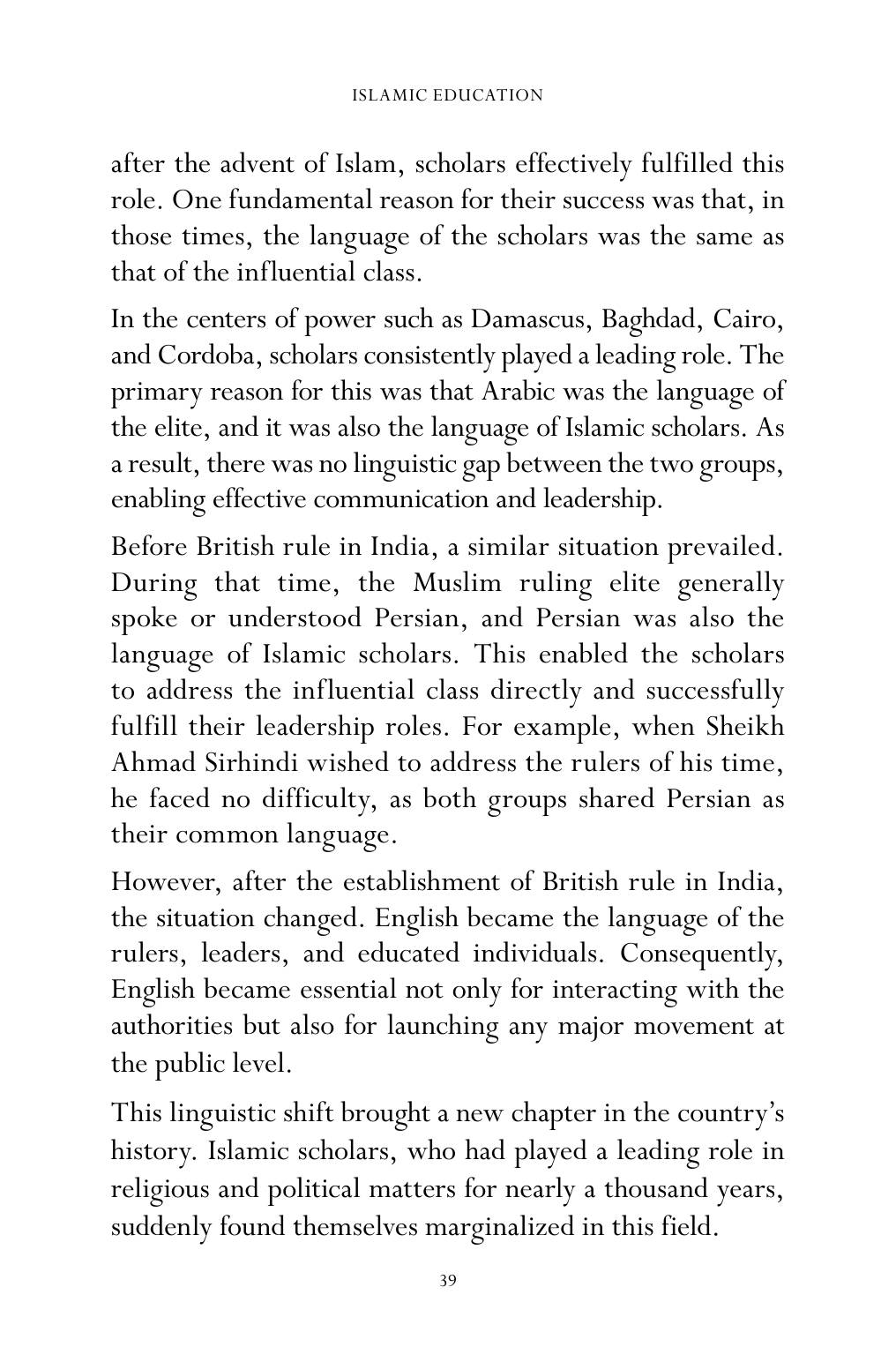
after the advent of Islam, scholars effectively fulfilled this role. One fundamental reason for their success was that, in those times, the language of the scholars was the same as that of the influential class. In the centers of power such as Damascus, Baghdad, Cairo, and Cordoba, scholars consistently played a leading role. The primary reason for this was that Arabic was the language of the elite, and it was also the language of Islamic scholars. As a result, there was no linguistic gap between the two groups, enabling effective communication and leadership. Before British rule in India, a similar situation prevailed. During that time, the Muslim ruling elite generally spoke or understood Persian, and Persian was also the language of Islamic scholars. This enabled the scholars to address the influential class directly and successfully fulfill their leadership roles. For example, when Sheikh Ahmad Sirhindi wished to address the rulers of his time, he faced no difficulty, as both groups shared Persian as their common language. However, after the establishment of British rule in India, the situation changed. English became the language of the rulers, leaders, and educated individuals. Consequently, English became essential not only for interacting with the authorities but also for launching any major movement at the public level. This linguistic shift brought a new chapter in the country’s history. Islamic scholars, who had played a leading role in religious and political matters for nearly a thousand years, suddenly found themselves marginalized in this field.
‹ Previous page Next page › About this book Open in the reader