The Leadership Role of Scholars
English book, p. 40
By Maulana Wahiduddin Khan
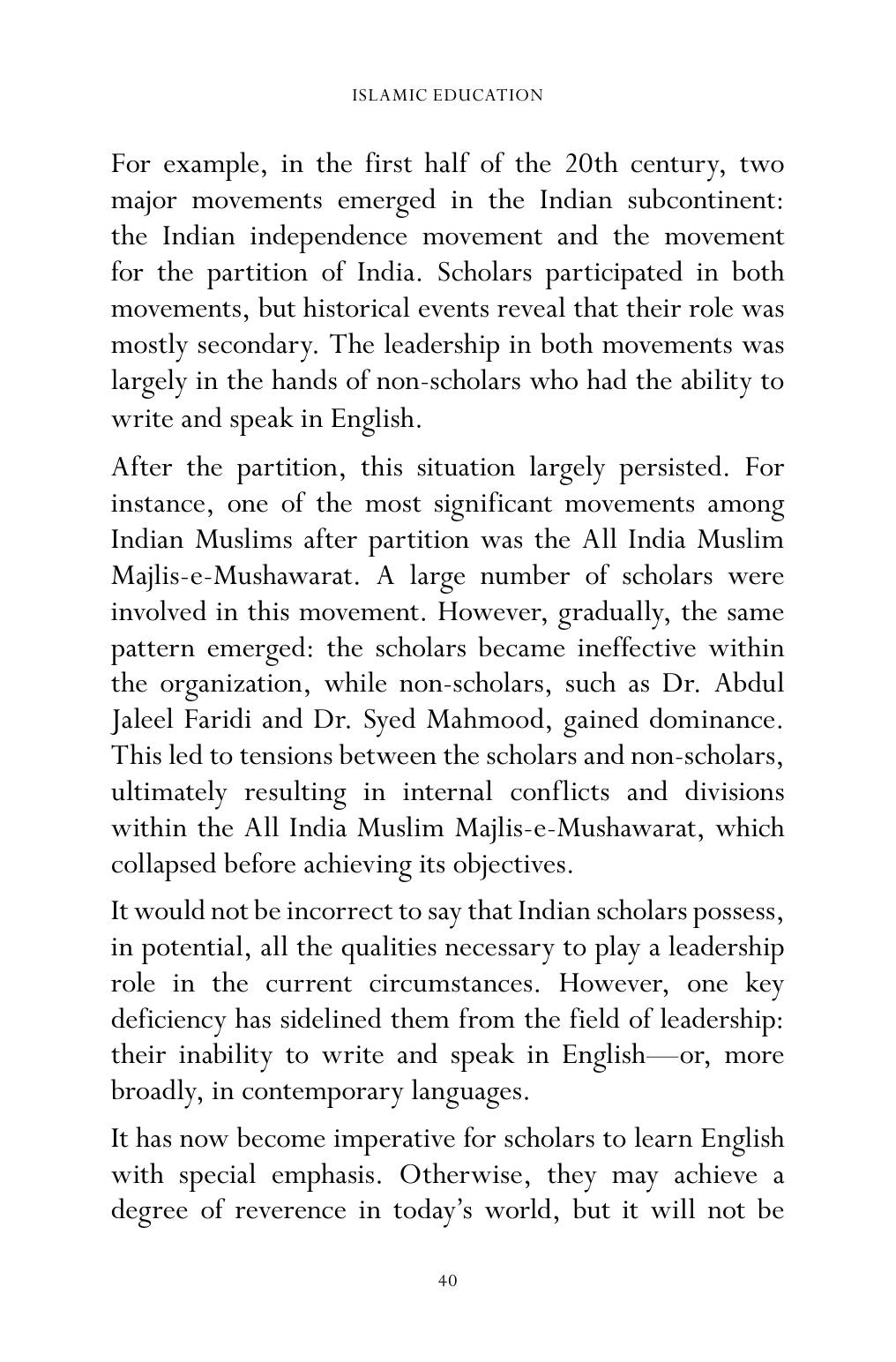
For example, in the first half of the 20th century, two major movements emerged in the Indian subcontinent: the Indian independence movement and the movement for the partition of India. Scholars participated in both movements, but historical events reveal that their role was mostly secondary. The leadership in both movements was largely in the hands of non-scholars who had the ability to write and speak in English. After the partition, this situation largely persisted. For instance, one of the most significant movements among Indian Muslims after partition was the All India Muslim Majlis-e-Mushawarat. A large number of scholars were involved in this movement. However, gradually, the same pattern emerged: the scholars became ineffective within the organization, while non-scholars, such as Dr. Abdul Jaleel Faridi and Dr. Syed Mahmood, gained dominance. This led to tensions between the scholars and non-scholars, ultimately resulting in internal conflicts and divisions within the All India Muslim Majlis-e-Mushawarat, which collapsed before achieving its objectives. It would not be incorrect to say that Indian scholars possess, in potential, all the qualities necessary to play a leadership role in the current circumstances. However, one key deficiency has sidelined them from the field of leadership: their inability to write and speak in English—or, more broadly, in contemporary languages. It has now become imperative for scholars to learn English with special emphasis. Otherwise, they may achieve a degree of reverence in today’s world, but it will not be
‹ Previous page Next page › About this book Open in the reader