I The Method of Argument
English book, p. 15
By Maulana Wahiduddin Khan
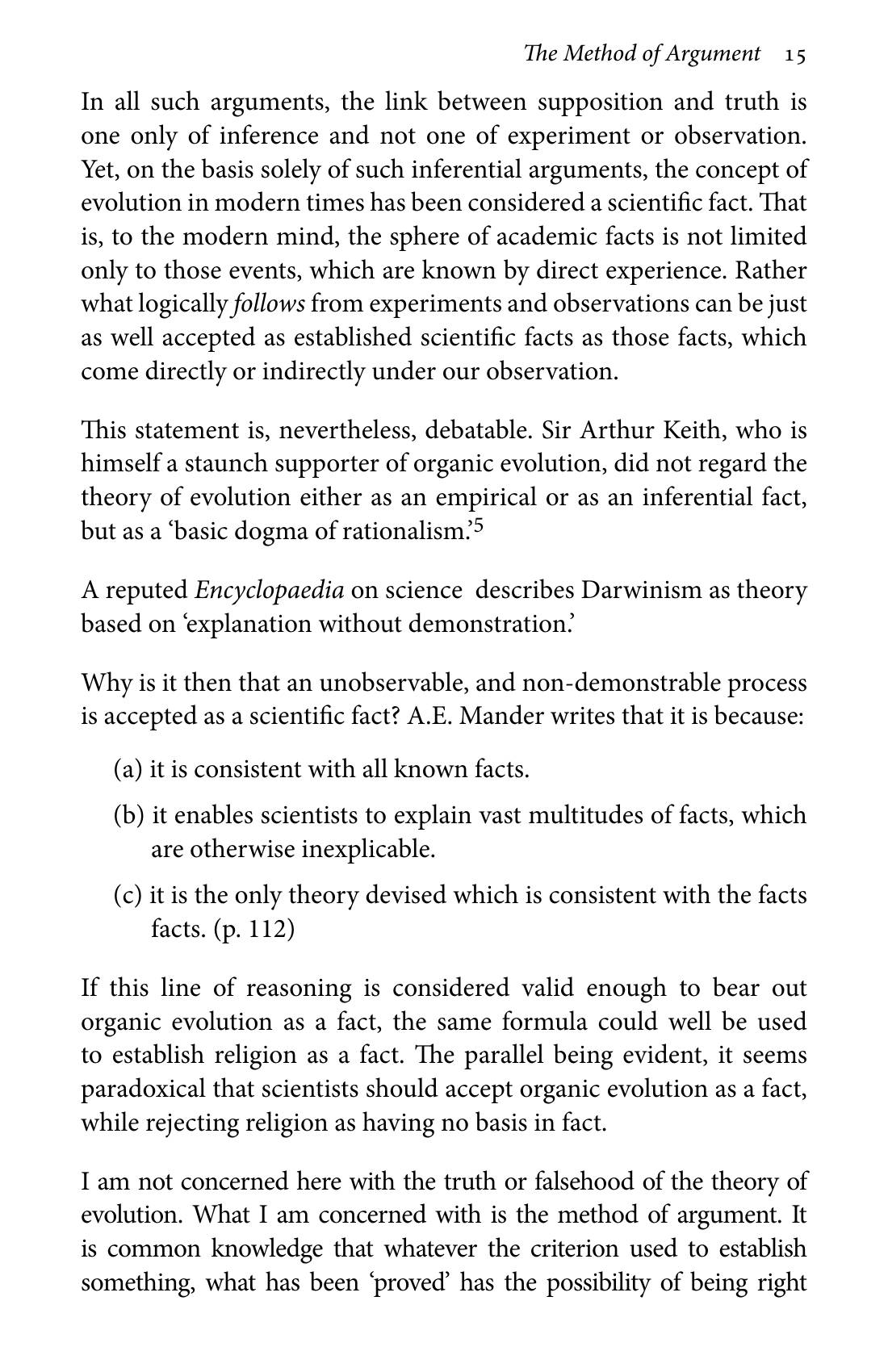
The Method of Argumen In all such arguments, the link between supposition and truth is one only of inference and not one of experiment or observation. Yet, on the basis solely of such inferential arguments, the concept of evolution in modern times has been considered a scientific fact. That is, to the modern mind, the sphere of academic facts is not limited only to those events, which are known by direct experience. Rather what logically follows from experiments and observations can be just as well accepted as established scientific facts as those facts, which come directly or indirectly under our observation. This statement is, nevertheless, debatable. Sir Arthur Keith, who is himself a staunch supporter of organic evolution, did not regard the theory of evolution either as an empirical or as an inferential fact, but as a ‘basic dogma of rationalism.’5 A reputed Encyclopaedia on science describes Darwinism as theory based on ‘explanation without demonstration.’ Why is it then that an unobservable, and non-demonstrable process is accepted as a scientific fact? A.E. Mander writes that it is because: (a) it is consistent with all known facts. (b) it enables scientists to explain vast multitudes of facts, which are otherwise inexplicable. (c) it is the only theory devised which is consistent with the facts facts. (p. 112) If this line of reasoning is considered valid enough to bear out organic evolution as a fact, the same formula could well be used to establish religion as a fact. The parallel being evident, it seems paradoxical that scientists should accept organic evolution as a fact, while rejecting religion as having no basis in fact. I am not concerned here with the truth or falsehood of the theory of evolution. What I am concerned with is the method of argument. It is common knowledge that whatever the criterion used to establish something, what has been ‘proved’ has the possibility of being right
‹ Previous page Next page › About this book Open in the reader