Principles of Dialogue in Islam
English book, p. 108
By Maulana Wahiduddin Khan
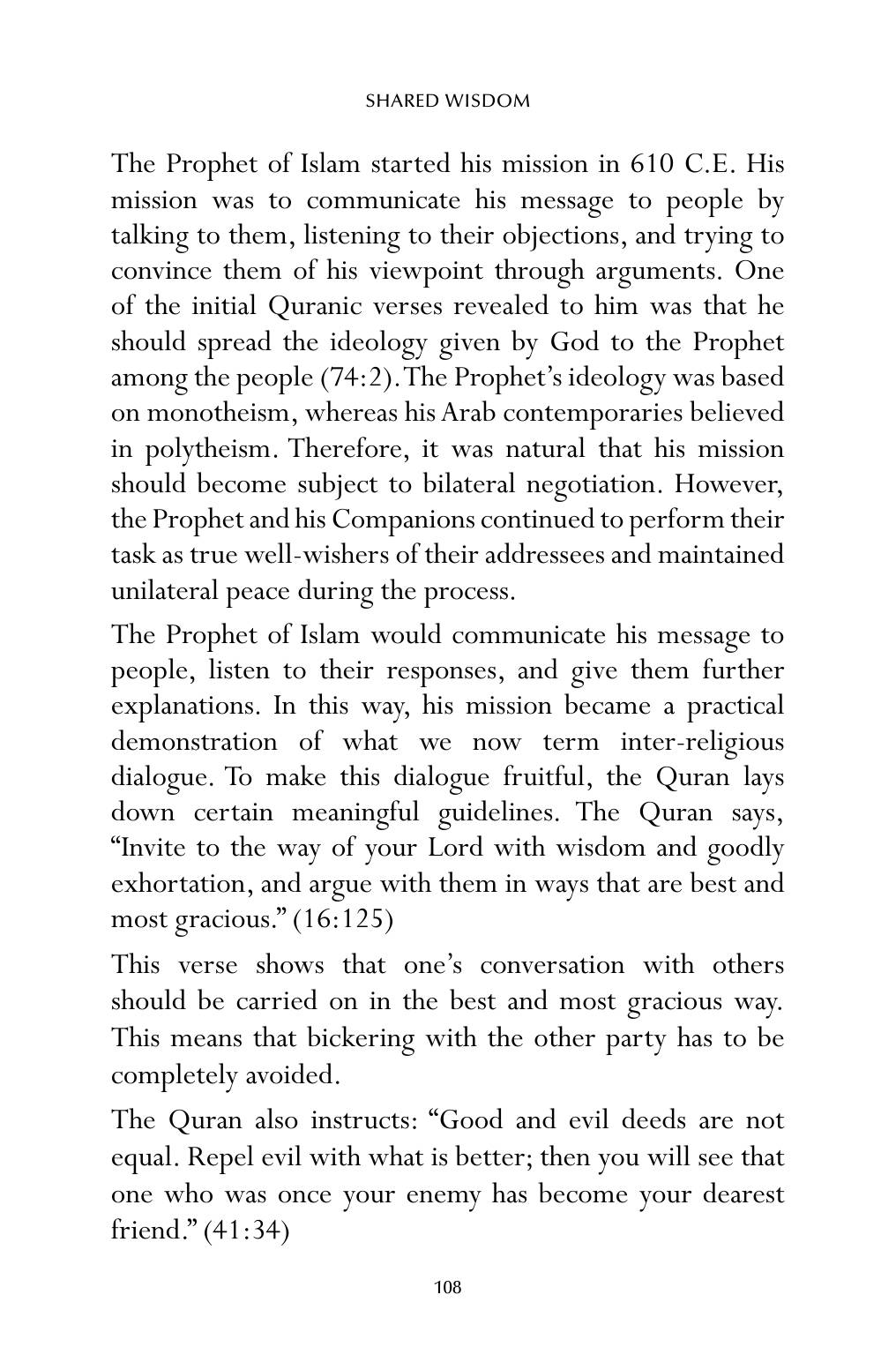
The Prophet of Islam started his mission in 610 C.E. His mission was to communicate his message to people by talking to them, listening to their objections, and trying to convince them of his viewpoint through arguments. One of the initial Quranic verses revealed to him was that he should spread the ideology given by God to the Prophet among the people (74:2). The Prophet’s ideology was based on monotheism, whereas his Arab contemporaries believed in polytheism. Therefore, it was natural that his mission should become subject to bilateral negotiation. However, the Prophet and his Companions continued to perform their task as true well-wishers of their addressees and maintained unilateral peace during the process. The Proph et of Islam would communicate his message to people, listen to their responses, and give them further explanations. In this way, his mission became a practical demonstration of what we now term inter-religious dialogue. To make this dialogue fruitful, the Quran lays down certain meaningful guidelines. The Quran says, “Invite to the way of your Lord with wisdom and goodly exhortation, and argue with them in ways that are best and most gracious.” (16:125) This verse shows that one’s conversation with others should be carried on in the best and most gracious way. This means that bickering with the other party has to be completely avoided. The Quran also instructs: “Good and evil deeds are not equal. Repel evil with what is better; then you will see that one who was once your enemy has become your dearest friend.” (41:34)
‹ Previous page Next page › About this book Open in the reader