Principles of Dialogue in Islam
English book, p. 109
By Maulana Wahiduddin Khan
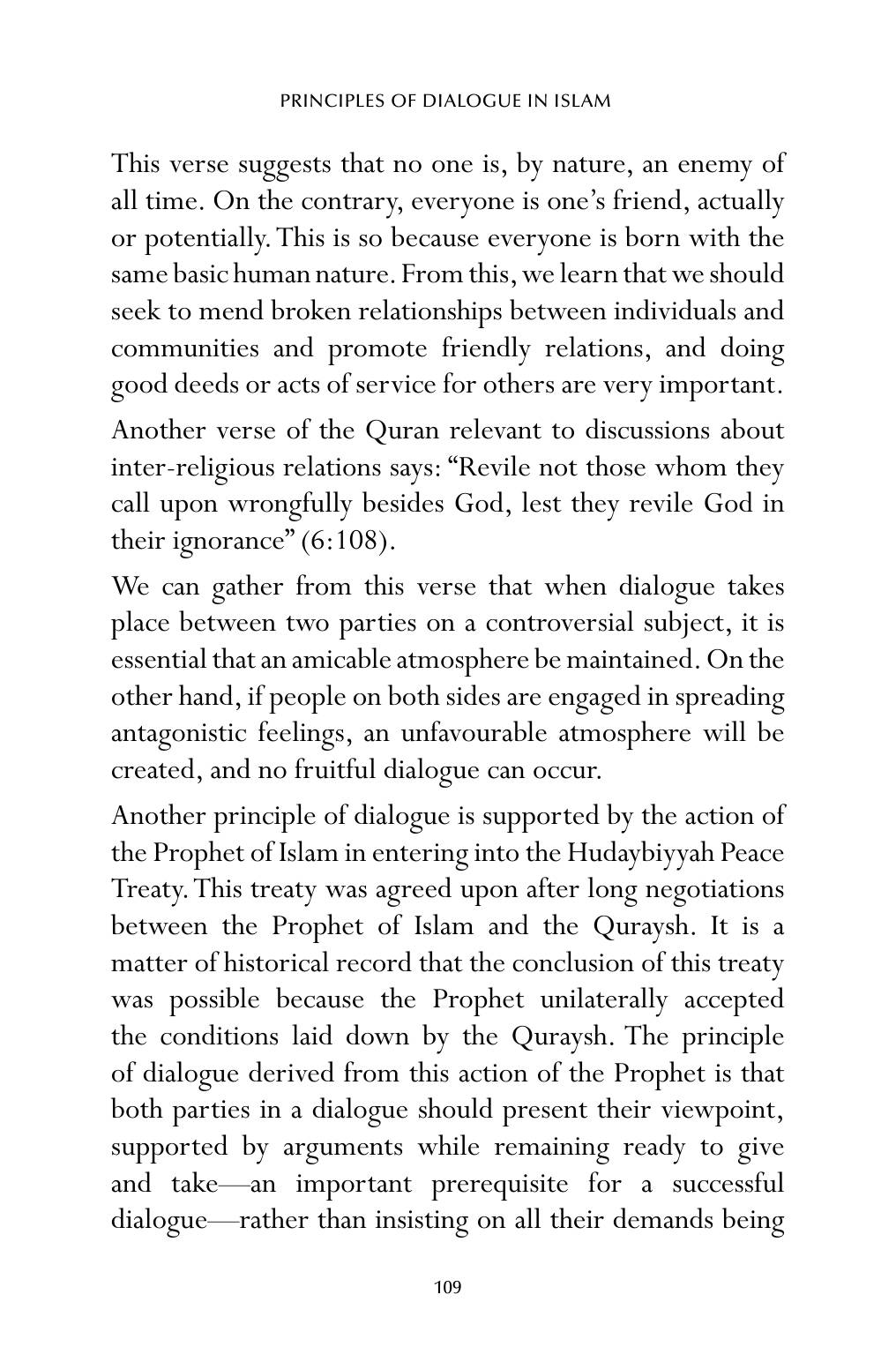
PRINCIPLES OF DIALOGUE IN ISLAM This verse suggests that no one is, by nature, an enemy of all time. On the contrary, everyone is one’s friend, actually or potentially. This is so because everyone is born with the same basic human nature. From this, we learn that we should seek to mend broken relationships between individuals and communities and p romote friendly relations, and doing good deeds or acts of service for others are very important. Another verse of the Quran relevant to discussions about inter-religious relations says: “Revile not those whom they call upon wrongfully besides God, lest they revile God in their ignorance” (6:108). We can gather from this verse that when dialogue takes place between two parties on a controversial subject, it is essential that an amicable atmosphere be maintained. On the other hand, if people on both sides are engaged in spreading antagonistic feelings, an unfavourable atmosphere will be created, and no fruitful dialogue can occur. Another principle of dialogue is supported by the action of the Prophet of Islam in entering into the Hudaybiyyah Peace Treaty. This treaty was agreed upon after long negotiations between the Prophet of Islam and the Quraysh. It is a matter of historical record that the conclusion of this treaty was possible because the Prophet unilaterally accepted the conditions laid down by the Quraysh. The principle of dialogue derived from this action of the Prophet is that both parties in a dialogue should present their viewpoint, supported by arguments while remaining ready to give and take—an important prerequisite for a successful dialogue—rather than insisting on all their demands being
‹ Previous page Next page › About this book Open in the reader