FOREWORD
English book, p. 12
By Maulana Wahiduddin Khan
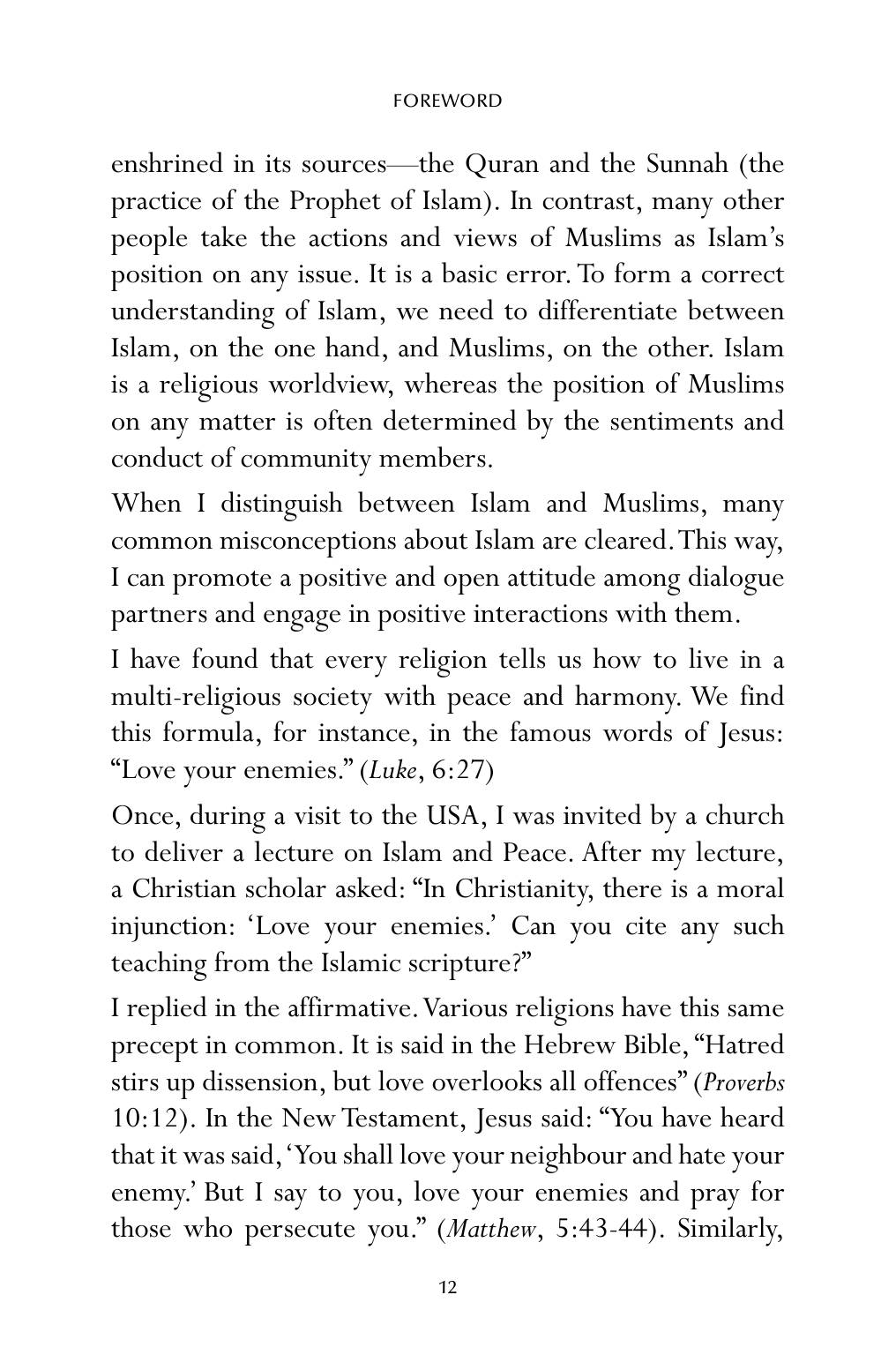
enshrined in its sources—the Quran and the Sunnah (the practice of the Prophet of Islam). In contrast, many other people take the actions and views of Muslims as Islam’s position on any issue. It is a basic error. To form a correct understanding of Islam, we need to differentiate between Islam, on the one hand, and Muslims, on the other. Islam is a religious worldview, whereas the position of Muslims on any matter is often determined by the sentiments and conduct of community members. When I distinguish between Islam and Muslims, many common misconceptions about Islam are cleared. This way, I can promote a positive and open attitude among dialogue partners and engage in positive interactions with them. I have found that every religion tells us how to live in a multi-religious society with peace and harmony. We find this formula, for instance, in the famous words of Jesus: “Love your enemies.” (Luke, 6:27) Once, during a visit to the USA, I was invited by a church to deliver a lecture on Islam and Peace. After my lecture, a Christian scholar asked: “In Christianity, there is a moral injunction: ‘Love your enemies.’ Can you cite any such teaching from the Islamic scripture?” I replied in the affirmative. Various religions have this same precept in common. It is said in the Hebrew Bible, “Hatred stirs up dissension, but love overlooks all offences” (Proverbs 10:12). In the New Testament, Jesus said: “You have heard that it was said, ‘You shall love your neighbour and hate your enemy.’ But I say to you, love your enemies and pray for those who persecute you.” (Matthew, 5:43-44). Similarly, FOREWORD
‹ Previous page Next page › About this book Open in the reader