In the Field of English Literature
English book, p. 29
By Maulana Wahiduddin Khan
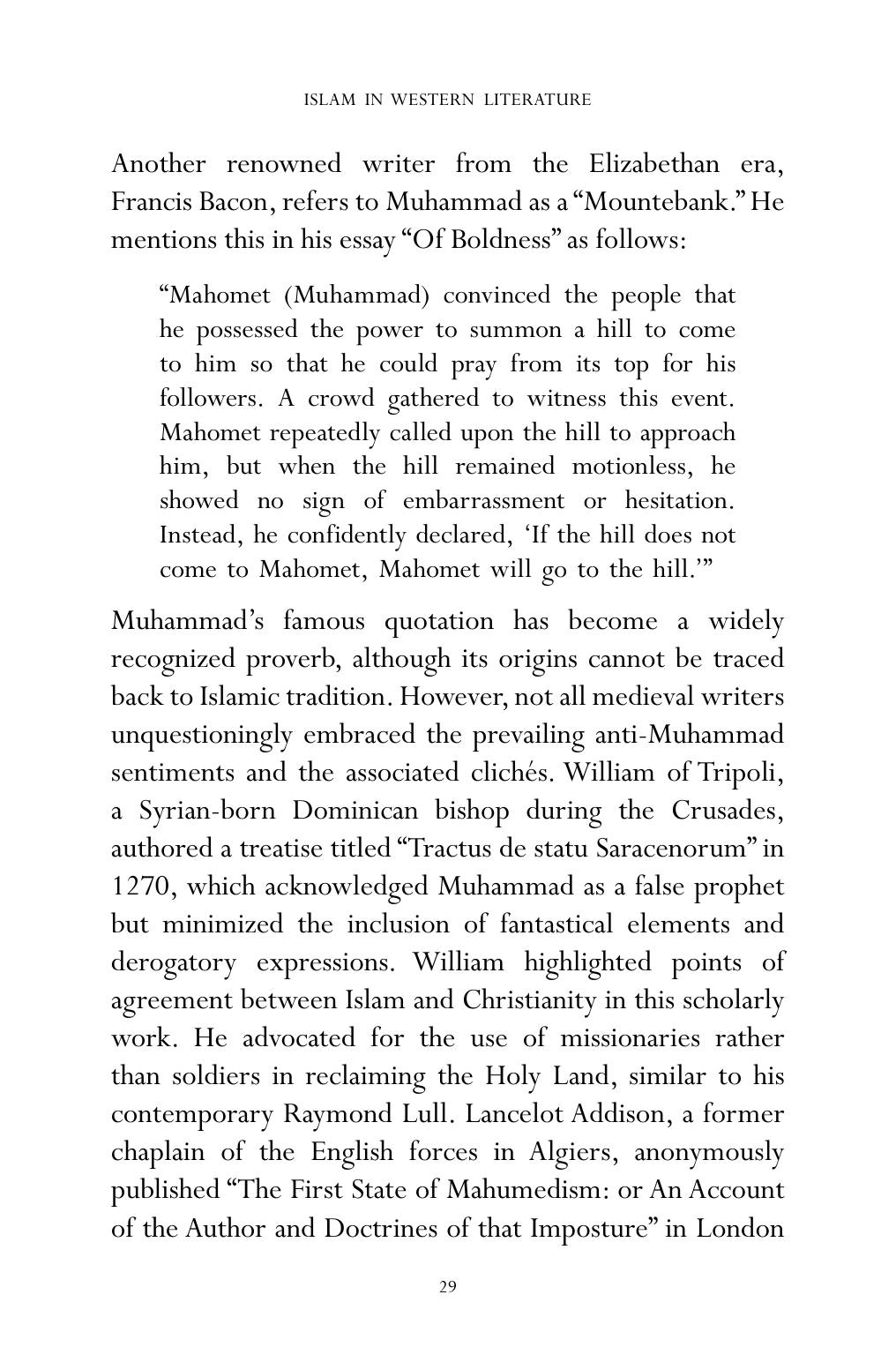
ISLAM IN WESTERN LITERATURE Another renowned writer from the Elizabethan era, Francis Bacon, refers to Muhammad as a “Mountebank.” He mentions this in his essay “Of Boldness” as follows: “Mahomet (Muhammad) convinced the people that he possessed the power to summon a hill to come to him so that he could pray from its top for his followers. A crowd gathered to witness this event. Mahomet repeatedly called upon the hill to approach him, but when the hill remained motionless, he showed no sign of embarrassment or hesitation. Instead, he confidently declared, ‘If the hill does not come to Mahomet, Mahomet will go to the hill.’” Muhammad’s famous quotation has become a widely recognized proverb, although its origins cannot be traced back to Islamic tradition. However, not all medieval writers unquestioningly embraced the prevailing anti-Muhammad sentiments and the associated clichés. William of Tripoli, a Syrian-born Dominican bishop during the Crusades, authored a treatise titled “Tractus de statu Saracenorum” in 1270, which acknowledged Muhammad as a false prophet but minimized the inclusion of fantastical elements and derogatory expressions. William highlighted points of agreement between Islam and Christianity in this scholarly work. He advocated for the use of missionaries rather than soldiers in reclaiming the Holy Land, similar to his contemporary Raymond Lull. Lancelot Addison, a former chaplain of the English forces in Algiers, anonymously published “The First State of Mahumedism: or An Account of the Author and Doctrines of that Imposture” in London
‹ Previous page Next page › About this book Open in the reader