Spirit of Islam, May-June 2022
Spirit of Islam, May-June 2022, p. 5
By Maulana Wahiduddin Khan
Maulana Wahiduddin Khan is named as the default author of the periodical; a piece that carries another writer’s byline is credited to that writer.
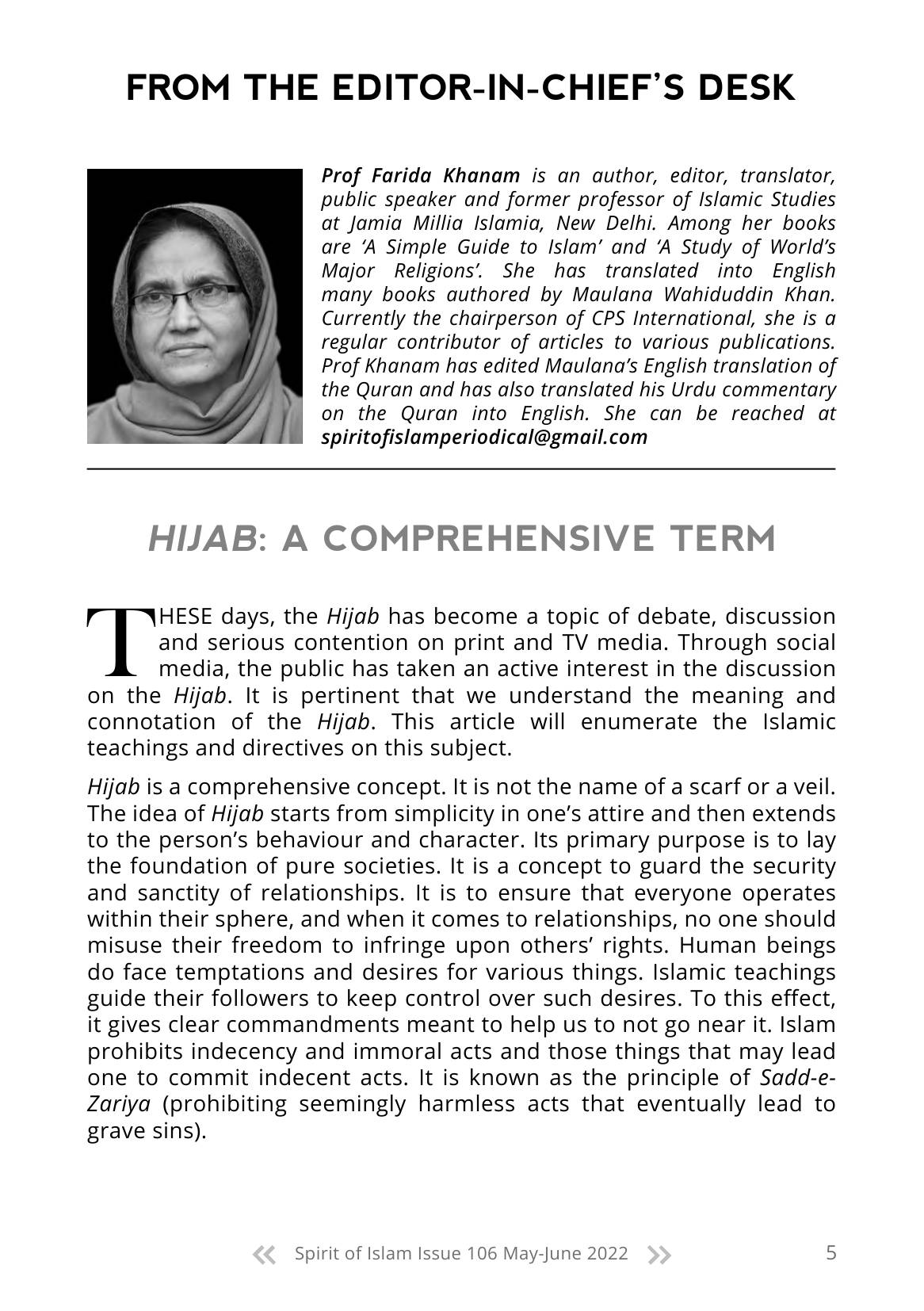
FROM THE EDITOR-IN-CHIEF’S DESK Prof Farida Khanam is an author, editor, translator, public speaker and former professor of Islamic Studies at Jamia Millia Islamia, New Delhi. Among her books are ‘A Simple Guide to Islam’ and ‘A Study of World’s Major Religions’. She has translated into English many books authored by Maulana Wahiduddin Khan. Currently the chairperson of CPS International, she is a regular contributor of articles to various publications. Prof Khanam has edited Maulana’s English translation of the Quran and has also translated his Urdu commentary on the Quran into English. She can be reached at spiritofislamperiodical@gmail.com HIJAB: A COMPREHENSIVE TERM T HESE days, the Hijab has become a topic of debate, discussion and serious contention on print and TV media. Through social media, the public has taken an active interest in the discussion on the Hijab. It is pertinent that we understand the meaning and connotation of the Hijab. This article will enumerate the Islamic teachings and directives on this subject. Hijab is a comprehensive concept. It is not the name of a scarf or a veil. The idea of Hijab starts from simplicity in one’s attire and then extends to the person’s behaviour and character. Its primary purpose is to lay the foundation of pure societies. It is a concept to guard the security and sanctity of relationships. It is to ensure that everyone operates within their sphere, and when it comes to relationships, no one should misuse their freedom to infringe upon others’ rights. Human beings do face temptations and desires for various things. Islamic teachings guide their followers to keep control over such desires. To this effect, it gives clear commandments meant to help us to not go near it. Islam prohibits indecency and immoral acts and those things that may lead one to commit indecent acts. It is known as the principle of Sadd-eZariya (prohibiting seemingly harmless acts that eventually lead to grave sins).
‹ Previous page Next page › About this issue Open in the reader